En
 Fr
 De
 It
 Es
 Uk
What is custom CRM and ERP development?
Custom CRM and ERP development is building an internal business system that follows your own processes instead of adapting your company to a generic tool. A CRM (customer relationship management system) covers clients, leads, deals, orders and communication. An ERP (enterprise resource planning system) goes further into operations: scheduling, staff, warehouse, purchasing, compliance and finance. Many companies need a mix of both in one platform.
Lytvynov Production builds custom CRM and ERP systems for companies of roughly 10 to 200 people in the US, UK and EU. Our core stack is PHP/Symfony on the back end and React on the front end, which suits systems with many business rules, roles and screens that need to run reliably for years. We work in English and French, and every project starts with a written scope and a fixed quote.
When should you build a custom CRM or ERP instead of buying one?
You should build a custom CRM or ERP when your workflow is a competitive advantage, when off-the-shelf tools need expensive workarounds, or when license costs for your whole team keep growing. You should buy when your process is standard and a known product covers 80% of it.
| Situation | Off-the-shelf CRM or ERP | Custom system |
|---|---|---|
| Standard sales pipeline, small team | Usually the better choice | Rarely worth it |
| Orders become service jobs, schedules and stock movements | Heavy customization or several tools glued together | One data model built for it |
| Industry rules and compliance records | Often missing or paid add-ons | Built into the workflow |
| Many staff roles (field workers, warehouse, office, management) | Per-seat licenses for everyone | No per-seat fees, roles designed for each group |
| Spreadsheets and chats hold the real process | Teams keep the spreadsheets anyway | The spreadsheets become screens and rules |
| Integrations with your own or local services | Limited to the vendor's marketplace | Any API, including your own |
| Long-term ownership of data and logic | Vendor controls roadmap and pricing | You own the code and the data |
A useful test: list the five things your team does every day that the current tool cannot do without a workaround. If that list is long and specific to your business, a custom system usually pays back. If it is short, configure an existing product instead, and we will tell you so in the scoping call.
What can a custom CRM or ERP include?
A custom CRM or ERP can include any module your company runs on, and the right first release covers only the ones that remove the most manual work. These are the modules we build most often:
- Clients and contacts: company and person profiles, history of orders, calls and emails, documents and notes in one card.
- Leads, deals and orders: intake from your website, email or messengers, a board from new to done, statuses that trigger the next step automatically.
- Service and job scheduling: calendars for jobs, crews and equipment, synced with Google or Apple calendars.
- Staff and shifts: who works when, task assignment, time tracking and workload views.
- Warehouse and inventory: stock levels in real time, reservations for orders, receiving and write-offs.
- Compliance and documents: required records, certificates and deadlines, with reminders before something expires.
- Finance hooks: quotes, invoices and payment status, connected to your accounting software instead of replacing it.
- Dashboards and reports: the numbers management actually checks every week, without exporting to Excel.
- Roles and permissions: what a field worker, a warehouse clerk, a manager and an owner can see and change, with an audit log.
- Notifications: email, Telegram, Slack or in-app alerts when something needs a person.
Which custom CRM and ERP systems have we built?
We have built internal systems for clients in aviation services, telecom support and subscription retail, and we run our own internal tools the same way:
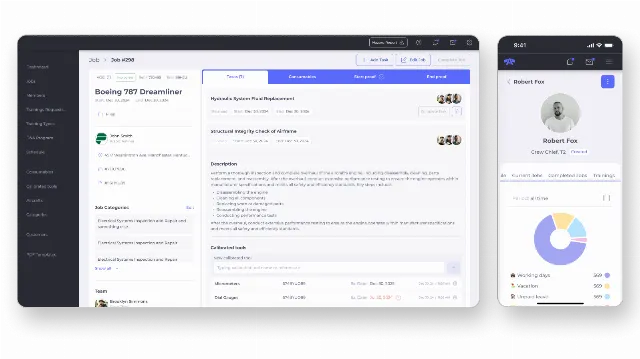
- Custom ERP for a US aircraft service company: built over six months on Symfony/PHP, React, SQL and Mercure. One platform for client profiles, order processing, aircraft service scheduling, staff and shift management synced with Google Calendar and Apple Calendar, real-time warehouse inventory and regulatory compliance monitoring, used by everyone from technicians to the CEO.
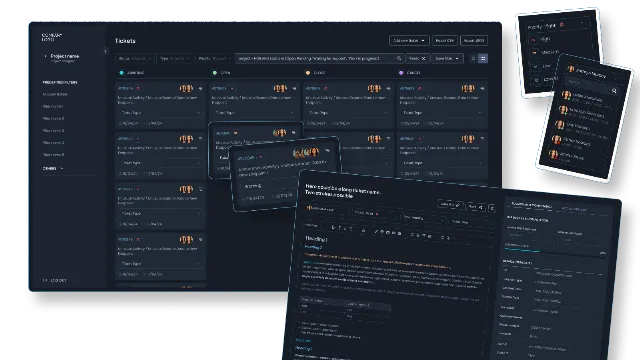
- Task and ticket management system for a telecom support company in France: an internal CRM built in three months that processes tickets from third-party alarm systems and manual tasks, with role-based access through Keycloak, team assignment, time tracking and automated notifications.
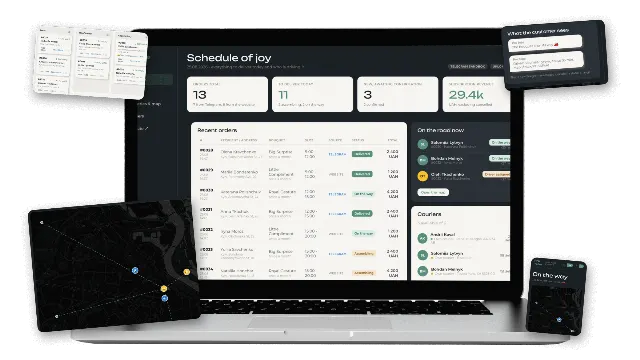
- CRM and delivery dispatch for a flower subscription studio: an order board, courier management, one-click dispatch to Uklon Delivery, a live map and customer tracking in Telegram, in English and Ukrainian.
Internally, our team runs projects on a project board we built ourselves, with an MCP server that our engineers and AI coding agents use every day. We know what an internal system feels like when you depend on it for your own work.
How does custom CRM and ERP development work with us?
Custom CRM and ERP development works best in modules: one workflow goes live, people start using it, and the next module builds on real feedback. We usually run it in four stages:
- Scoping (1 to 2 weeks): we map your current process, the spreadsheets and tools in use, roles and integrations, then write the scope of the first release and give a fixed quote.
- First module (6 to 10 weeks): the workflow that hurts most, usually orders or jobs, with roles, notifications and data imported from your current files.
- Further modules (4 to 8 weeks each): scheduling, warehouse, compliance, reporting or customer portals, each one demoed, tested with your staff and released.
- Support and growth: monitoring, backups, updates and new features on a monthly plan, or as a dedicated team if the system keeps growing.
Every week ends with a demo on a staging server. The code is in your repositories from day one, and you can see progress on the board at any time.
How do you integrate a custom CRM or ERP with other systems?
A custom CRM or ERP should connect to the tools your company already relies on rather than replace all of them. We integrate through APIs and webhooks, and we keep each integration behind its own interface so that it can be tested and replaced without touching the rest of the system.
Typical integrations: accounting and invoicing software, payment providers such as Stripe, Google Workspace and Microsoft 365 calendars and email, Telegram, WhatsApp or Slack for notifications, delivery and logistics APIs, identity providers such as Keycloak, Google or Microsoft for single sign-on, and your website forms for incoming leads. In the flower subscription project, every integration had a sandbox implementation behind the same interface, so the whole flow worked in demos before the real credentials were connected.
How do you add AI to a CRM or ERP without risk?
AI in a CRM or ERP should remove typing and searching, not make decisions nobody can check. We add AI features once the core workflows are stable and the data model is clean, and every AI action that changes data goes through a person first.
Useful AI features in internal systems:
- Turning incoming emails, PDFs and photos of documents into draft records.
- Summarizing a client's history before a call.
- Searching orders, jobs and notes in plain language.
- Drafting replies, quotes or reports for a person to approve.
- Flagging overdue jobs, unusual orders or missing compliance documents.
We build these with the OpenAI or Anthropic Claude APIs, log every call and measure accuracy on your real data. For larger automation of back-office work, see our AI automation services.
How much does a custom CRM or ERP cost?
A full ERP/CRM for a mid-size company typically costs $40,000 to $90,000 with us, and a smaller internal tool for one department starts at our $10,000 minimum; we give a fixed quote after a short scoping call, and you can get a first range with our project estimate form. The price depends on the number of modules and roles, integrations, data migration and how much reporting you need. To understand how fixed milestones compare with a monthly team, read dedicated team vs fixed price.
Can you take over or replace an existing internal system?
Yes. Many companies come to us with an internal system that still runs the business but is hard to change: an old PHP application, a heavily customized CRM, or a set of scripts around spreadsheets. We start with a short audit of the code, data and hosting, then choose between a gradual modernization and a replacement built module by module next to the old system. Our guide on modernizing a legacy PHP application explains how we decide. If the old system is in Symfony or plain PHP, our Symfony development team can usually continue it directly.
Next step
Send us how your team works today: the tools, the spreadsheets and the three tasks that take the most time. In a short scoping call we will tell you honestly whether a custom CRM or ERP is worth it, what the first module should be, and what it would cost. If you need more than an internal system, see our custom software development services. Book a CRM/ERP scoping call.