 En
En
 Fr
Fr
 De
De
 It
It
 Es
Es
 Uk
Uk
Why hire a Symfony development company instead of individual developers?
Hiring a Symfony development company gives you a working team with shared practices from the first week, instead of assembling and managing individual hires yourself. Freelancers work well for small, well-defined tasks. In-house hiring works well for the long term but typically takes months per senior Symfony developer. A dedicated team from a company fills the gap: architecture, code review, QA and DevOps come included, and the team can grow or shrink with your roadmap.
Symfony is not a side skill for us. PHP/Symfony is the main back-end stack of Lytvynov Production, and many of the business platforms we have delivered, from a custom ERP to a creator marketplace, run on it.
| Option | Time to start | Best for | Main risk |
|---|---|---|---|
| Freelance Symfony developer | Days | Small fixes, short tasks | No backup, uneven code review |
| In-house hire | Often 2 to 4 months per senior | Core long-term team | Slow hiring, hard to scale down |
| Dedicated team from a company | 1 to 3 weeks | Product development, upgrades, scaling up quickly | Needs clear ownership and communication rules |
| Fixed-scope project | 1 to 3 weeks after scoping | New build or upgrade with defined outcome | Scope changes need a change process |
What does a dedicated Symfony team look like?
A dedicated Symfony team is a stable group of engineers who work only on your product, inside your processes, for months or years. A common starting shape is one senior Symfony engineer who owns architecture plus one or two Symfony developers, with a front-end developer (React, Vue or Angular), QA and DevOps added part time when needed.
The team works in your repositories and ticket system, joins your standups, and follows your code review and release rules, or brings its own if you do not have them yet. We work in English (and French when useful), with overlapping hours for both European and US time zones. Internally we use AI coding agents under senior engineer review for routine work such as tests, migrations and refactors, which leaves more of the budget for the parts that need human judgment. For how working with a Ukrainian team compares to other options, see outsourcing software development to Ukraine.
How do we build new Symfony applications?
New Symfony applications start with the domain, not the framework. We model the business entities and rules first, then map them to Doctrine entities, services and message handlers, keeping business logic out of controllers so it can be tested and reused.
Our default setup for a new build:
- Symfony on current PHP 8.x, strict types, PHPStan at a high level from day one.
- Doctrine ORM with PostgreSQL or MySQL and versioned migrations.
- API Platform for API-first products, or Twig with Symfony UX for server-rendered interfaces.
- Symfony Messenger with Redis or RabbitMQ for background jobs, emails, imports and integrations.
- Mercure for real-time updates in the browser.
- EasyAdmin for back offices that need to exist quickly.
- Docker, CI/CD and automated tests (PHPUnit, functional tests) in the pipeline before the first feature ships.
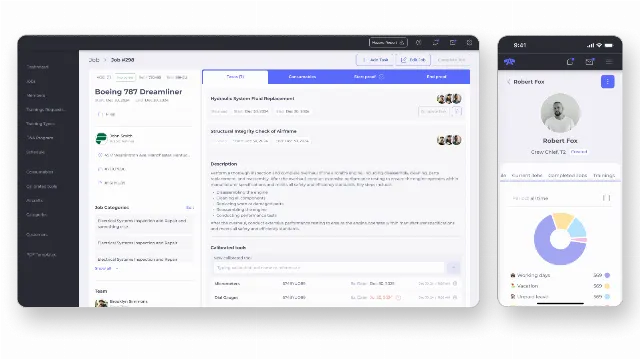
The custom ERP for a US aircraft service company was built this way over six months on Symfony/PHP, React, SQL and Mercure: client and order management, aircraft service scheduling, staff shifts synced with Google, Apple and Team calendars, real-time warehouse inventory and regulatory compliance tracking, used daily by everyone from ground staff to the CEO.
How do you upgrade legacy Symfony 4 or 5 projects to 6.4 or 7?
Upgrading a legacy Symfony project means moving one major version at a time, fixing deprecations before each jump, and keeping the application deployable throughout. Projects on Symfony 4.4 are well past end of support, and Symfony 5.4 has left regular bug-fix support, so they stop receiving normal fixes and often pin old, unsupported PHP versions. The target today is usually the current long-term support release in the 6.4 or 7.x line, depending on your PHP version and dependencies.
Our upgrade process:
- Audit (1 to 2 weeks): PHP and Symfony versions, deprecation log, bundles and their maintenance status, test coverage, hosting.
- Safety net: add smoke and functional tests on the critical flows if coverage is thin.
- PHP upgrade: move to a supported PHP 8.x version first, with Rector handling most syntax changes.
- One major Symfony version at a time: 4.4 to 5.4, 5.4 to 6.4, 6.4 to 7.x, clearing deprecations before each step.
- Replace abandoned bundles with maintained alternatives or small in-house code.
- Configuration and attributes: move annotations to PHP attributes, update security configuration to the new authenticator system.
- Release in stages with monitoring, so every step can be rolled back.
For very old code on Symfony 2 or 3, or plain PHP without a framework, we usually recommend a gradual migration: new features in a fresh Symfony application, old parts moved over module by module behind the same URLs.
How do we build APIs with API Platform?
API Platform is the fastest way to build a well-documented REST or GraphQL API on Symfony. It generates endpoints, OpenAPI documentation, pagination, filtering and validation from your resources, so the team spends time on business rules instead of boilerplate.
We use API Platform for back ends that serve React or Vue web apps, React Native or Flutter mobile apps and partner integrations. Where business operations do not map to simple create, read, update and delete, we write custom state providers and processors, or expose explicit action endpoints. Security rules are defined per operation and covered by tests, and multi-tenant filtering is applied at the Doctrine level so no endpoint can leak another customer's data. This is the same approach we use for SaaS development.
How do you fix Symfony and PHP performance problems?
Symfony performance problems are almost always in the database layer or in work done during the request that should run in the background. We start by measuring with a profiler on real traffic patterns, then fix the largest cost first.
Common findings and fixes:
| Symptom | Typical cause | Fix |
|---|---|---|
| Slow list pages | Doctrine N+1 queries, missing indexes | Eager loading or DTO queries, proper indexes |
| Slow API responses under load | Hydrating full entities for simple reads | Read models, partial queries, HTTP caching |
| Timeouts on imports or exports | Heavy work inside the web request | Symfony Messenger workers, batching |
| High server cost | No OPcache preloading, no cache layer | OPcache and preloading, Redis cache, cache pools |
| Memory spikes in commands | Unbounded Doctrine unit of work | Batch processing with periodic clears |
Ritoria, a Symfony platform we built with 54 domain entities, three payment providers and an EasyAdmin back office of 38 sections, ran in production on AWS for two and a half years through 120 database migrations. Long-lived products like that stay fast only when performance checks are part of regular development, not an emergency project.
How we work with Symfony teams
We start with a short call and, for existing projects, a code audit that ends with a written report and a plan. For new builds we start with scoping and a fixed quote for the first milestone. Then we either deliver fixed-scope milestones or provide a dedicated Symfony team on a monthly basis, with code and infrastructure always in your accounts. If you are still choosing a framework, read Symfony vs Laravel for SaaS.
Book a call with a Symfony lead and tell us about your project, your current Symfony version and what is not working.