 En
En
 Fr
Fr
 De
De
 It
It
 Es
Es
 Uk
Uk
What is a dedicated development team?
A dedicated development team is a group of engineers who work only on your product, full time, taking priorities from you, while the vendor handles hiring, employment, equipment and replacements. The team behaves like an internal product team: it owns a backlog, ships to your environments and joins your planning. What you do not carry is recruitment time, payroll administration and the risk of an empty seat when someone leaves.
The dedicated team model fits products that keep evolving: a SaaS after its first release, an internal platform that more departments start to depend on, a legacy system that needs steady modernization. It fits less well when the scope is fixed and the finish line is clear; for that, a fixed-price engagement is cleaner. Our guide on dedicated team vs fixed price compares the models in detail.
Which roles can a dedicated software development team include?
A dedicated software development team is shaped around the product, not a standard package. Most teams start with two to five people and grow once the backlog proves it. These are the roles we staff and when each one is worth paying for:
| Role | What the role covers | When you need it |
|---|---|---|
| Tech lead / senior back-end (PHP/Symfony) | Architecture, code review, API design, technical decisions | Always, one per team |
| Back-end engineer | Features, integrations, data model changes, background jobs | Most products |
| Front-end engineer (React, Vue or Angular) | Web app, admin panels, design system implementation | Any product with a web interface |
| Mobile engineer (React Native or Flutter) | iOS and Android apps, push notifications, store releases | When mobile is part of the product |
| AI engineer | LLM features, retrieval (RAG), evaluation, model integration, MCP servers | When AI features are on the roadmap |
| QA engineer | Test plans, regression testing, automated test coverage | From three or more developers, or regulated domains |
| DevOps (part time) | Docker, CI/CD pipelines, hosting, monitoring, backups | Usually shared, a few days a month |
| Designer (part time) | UX flows, UI design in Figma, design system upkeep | When new features change the user experience |
Symfony is our main back-end stack, so a Symfony-heavy team is where we are strongest. For more on that stack specifically, including legacy upgrades, see Symfony development.
How does onboarding work in the first 30 days?
Onboarding a dedicated team takes about a month to reach steady speed, and the first week sets the tone. We follow the same sequence for every new team:
- Days 1-3: access and context. Accounts in your repositories, tracker, cloud and communication tools. Walkthrough of the product with you and, if there is one, your current team.
- Days 3-7: codebase review. The tech lead maps the architecture, runs the project locally, and writes a short note on risks, test coverage and technical debt.
- Week 2: first release. A small, real change goes to production through your pipeline, which proves the whole path from ticket to deploy works.
- Weeks 2-4: first sprint cycle. Planning, daily async updates, a demo at the end of the sprint, and a retrospective on what to change in the process.
- Day 30: review with you. What was delivered, what slowed the team down, and whether the team shape is right for the next quarter.
When the team takes over from another vendor or an in-house group, we ask for an overlap period with the previous developers. A few days of paired walkthroughs saves weeks of reverse engineering.
How will you know what the team is doing?
You know what a dedicated team is doing through artifacts, not status meetings: the tracker, the pull requests, the demo and a short written report. Every week you get a demo of working software on a staging environment and a written summary of what shipped, what is in progress, what is blocked and what decisions are needed from you. Sprint planning happens with you or your product owner, and every ticket links to the code that implements it.
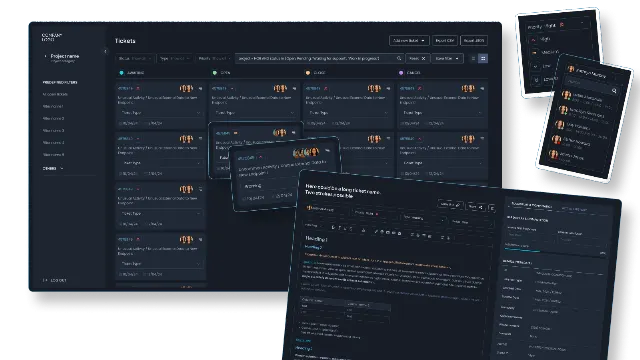
Our own work runs on an internal project board we built for this purpose, with AI coding agents working under senior engineers and every change reviewed by a person before it merges. If you already have Jira, Linear or another tracker, the team works in yours; the reporting habits stay the same. Time zones are covered in the FAQ above: the European day fully, US East Coast mornings as the live-call window.
Who owns the code, and what if someone leaves?
You own everything the dedicated team builds, and the setup should make that true in practice, not only in the contract. The contract transfers all intellectual property to you on payment, and includes confidentiality and non-solicitation terms. In practice, repositories, cloud accounts, domains, app store accounts and AI provider accounts are opened in your company's name, with the team invited as members.
People do leave, and the question is how much it costs you. Our approach: you are told early, we propose a replacement for your approval, and the outgoing and incoming engineers overlap on real tickets. Code review by at least two people, a tech lead who knows the whole system, and short architecture notes in the repository mean that no single person is the only one who understands a critical part.
How does a dedicated team compare to other ways of building?
A dedicated team sits between hiring in-house and buying a fixed-scope project. Each option trades control, speed and cost differently:
| In-house hires | Dedicated team | Fixed-price project | Freelancers | |
|---|---|---|---|---|
| Time to start | 2 to 4 months per hire | 2 to 8 weeks | 2 to 4 weeks after scoping | Days |
| Control over priorities | Full | Full, week to week | Limited to agreed scope | Per person |
| Handles changing scope | Yes | Yes | Only through change requests | Yes, with coordination effort |
| Replacement risk | Yours | Vendor's | Vendor's | Yours |
| Best for | Long-term core team | Evolving product, 6+ months | Well-defined build with a finish line | Small, isolated tasks |
Which long-running products have we built?
Our longer engagements look like dedicated team work: a stable group, one product, continuous delivery.
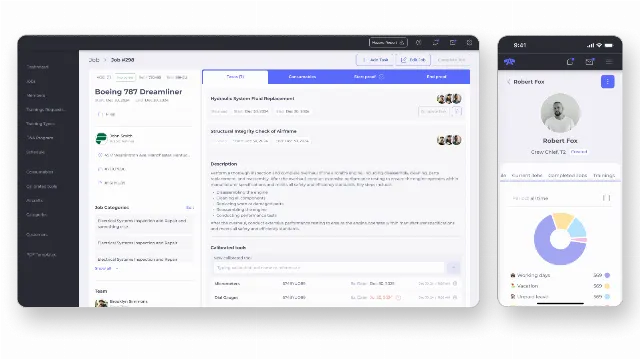
- Custom ERP for a US aircraft service company: six months of development in Symfony/PHP, React, SQL and Mercure, unifying client and order management, service scheduling, staff shifts with calendar integrations, warehouse inventory and regulatory compliance into one system used from ground workers to the CEO.
- Ritoria: a Symfony platform with 54 domain entities, three payment providers and English and Arabic interfaces, which ran in production on AWS for two and a half years with 292 commits and 120 database migrations of continuous evolution.
- Task management system for a telecom support team in France: an internal ticketing tool with third-party alarm integration, role-based access through Keycloak and automated notifications, built in three months.
What does a dedicated development team cost?
A dedicated development team is priced as a monthly fee, driven by the number of engineers, their seniority, the stack and how many part-time roles (QA, DevOps, design) the product needs. A US agency or US in-house team typically costs 2 to 4 times more for the same capacity, and a team of three to four people from Ukraine is often comparable in cost to one or two US in-house hires once benefits, recruiting and management time are counted.
We quote a monthly team cost after a short planning call. Our guides on offshore software development cost and outsourcing software development to Ukraine cover hidden costs, contracts and continuity in more detail. If your scope fits a fixed-price project instead, most MVPs land at $10,000 to $20,000 with us.
How to hire a dedicated development team with us
Start with a 30-minute call about your product, your current team and the next six months of roadmap. We propose a team shape, a start date and a monthly cost, then run a short scoping phase to agree on the first backlog and access. The team starts in your repositories, and the team size changes as the roadmap does. Book a team planning call.