En
 Fr
 De
 It
 Es
 Uk
How much does custom CRM development cost in 2026?
With Lytvynov Production a custom CRM starts from $10,000 for a focused tool used by one team, and a full CRM/ERP for a mid-size company typically costs $40,000 to $90,000. A typical US or UK agency quotes roughly 2.5 to 4 times more for the same scope. A first production release usually takes 8 to 12 weeks, and you can get a first range for your project with our estimate form.
The price depends far more on your process than on the word "CRM". Two companies with ten salespeople each can need systems that differ by a factor of four: one needs contacts, deals and email sync, the other needs orders that turn into jobs, crews, stock reservations and compliance records. This guide is written for the second kind of company, the one where a standard CRM keeps forcing workarounds.
What are typical custom CRM price ranges by scope?
Most custom CRMs we scope fall into one of three sizes. The table shows our typical ranges for the build (design, development, data migration and a pilot) next to what a typical US or UK agency quotes for similar scope.
| CRM scope | What is inside | First release | With Lytvynov Production | Typical US/UK agency |
|---|---|---|---|---|
| Focused CRM for one team | Clients and contacts, orders or deals, a status board, roles, notifications, import from spreadsheets | 8 to 12 weeks | from $10,000 | $25,000 to $60,000 |
| CRM for several departments | The above plus scheduling, documents, reporting, 3 to 6 integrations, a client portal or mobile view | 3 to 5 months | $10,000 to $40,000 | $40,000 to $160,000 |
| Full CRM/ERP for a mid-size company | Sales, operations, staff and shifts, warehouse, compliance, finance hooks, many roles | 4 to 6 months, in modules | $40,000 to $90,000 | $100,000 to $360,000 |
Treat these as orientation. We give a fixed quote after a short scoping call, split into milestones, because the real scope only becomes visible once we have seen your spreadsheets and the five things your team works around every day.
Running costs come on top and are modest compared with per-seat licenses: hosting for a CRM used by 20 to 100 people usually costs $50 to $400 a month, and a maintenance plan for updates, small changes and monitoring is commonly budgeted at 15 to 20 percent of the build cost per year.
When does a custom CRM beat Salesforce or HubSpot?
A custom CRM beats Salesforce or HubSpot when your core workflow does not look like a sales pipeline, when many people outside sales need access, or when three years of licenses, add-ons and customization cost more than owning the system. If your process is a standard B2B sales funnel run by a small team, buy the vendor product.
| Situation | Salesforce or HubSpot | Custom CRM |
|---|---|---|
| Small sales team, standard pipeline | Usually the right choice | Rarely worth it |
| Orders turn into jobs, schedules and stock movements | Heavy customization or several tools glued together | One data model built for it |
| Field staff, warehouse and office all need access | Per-seat license for each person | No per-seat fees |
| Industry rules and compliance records | Paid add-ons or custom objects | Built into the workflow |
| Integrations with local or in-house services | Marketplace connectors only, or custom code anyway | Any API |
| Pricing rules, approvals and documents specific to you | Admin consultants and custom code | Part of the core logic |
A quick test we use in scoping calls: write down the five tasks your team does every day that the current CRM cannot do without a spreadsheet, a chat message or a manual copy. If the list is long and specific to your business, a custom CRM usually pays back. If it is short, configure the vendor product and spend the money elsewhere.
What does a custom CRM cost over three years compared with a per-seat CRM?
Over three years the comparison is build cost plus hosting and maintenance against licenses plus customization. Here is an illustrative calculation with assumed numbers, not a quote.
A company of 40 people where everyone needs some CRM access. Business tiers of per-seat CRMs commonly run $50 to $300 per user per month once you add the features operations teams need. At an assumed $120 per user per month, licenses cost $57,600 a year, or about $172,800 over three years, before admin consultants and integrations.
The same company with a custom CRM in the middle of our ranges: a $40,000 build, $3,600 a year of hosting and about $7,000 a year of maintenance, which is roughly $72,000 over three years. The gap narrows if only 10 people need access and widens with every hire.
| Cost line over 3 years (illustrative) | Per-seat CRM, 40 users | Custom CRM |
|---|---|---|
| Licenses | about $172,800 | $0 |
| Build or customization | Admin and integration work, often $20,000+ | about $40,000 |
| Hosting | Included | about $10,800 |
| Maintenance | Admin time | about $21,000 |
| Total | about $190,000+ | about $72,000 |
Two caveats. A custom CRM needs an owner on your side who decides priorities, and the first release covers fewer generic features than a mature vendor product. If you need marketing automation, email sequences and a large app marketplace from day one, keep a vendor tool for those and build only the operational core.
What modules does a custom CRM usually include?
A custom CRM should start with the modules that remove the most manual work and leave the rest for later releases. These are the ones we build most often:
- Clients and contacts: company and person cards with orders, calls, emails, documents and notes in one place.
- Leads, deals or orders: intake from the website, email and messengers, a board from new to done, and statuses that trigger the next step.
- Tasks and tickets: assignment by team and role, priorities, labels, attachments and time tracking.
- Scheduling: jobs, crews and equipment on a calendar synced with Google or Apple calendars.
- Documents and quotes: generated PDFs, e-signature links, versioning.
- Reports: the five to ten numbers management checks every week, without exporting to Excel.
- Roles and audit log: who can see and change what, and a record of every change.
- Notifications: email, Telegram, Slack or in-app alerts when a person needs to act.
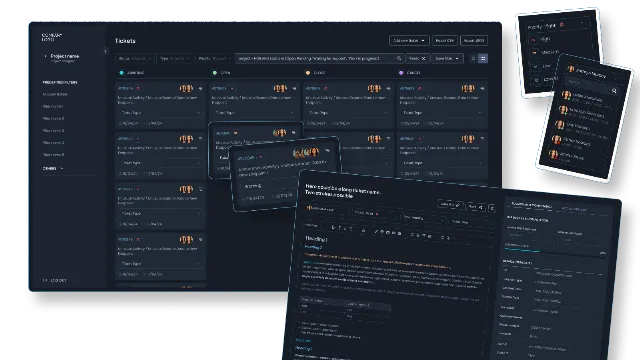
As an example of a focused first release, we built a task and ticket CRM for a telecom support company in France in three months. It takes tickets from third-party alarm systems and manual entry, assigns them by team and role, tracks time, notifies internal staff and external stakeholders, and authenticates users through Keycloak.
How long does it take to build a custom CRM?
A focused CRM for one team typically takes 8 to 12 weeks to its first production release, and a CRM for several departments 3 to 5 months delivered in modules. A realistic plan looks like this:
- Scoping (1 to 2 weeks): we map the current process, collect the spreadsheets, list roles and integrations, and agree on what the first release must do. You get a fixed quote split into milestones.
- Design (1 to 2 weeks, overlapping): screens for the main flows, checked with the people who will use them.
- First module (6 to 10 weeks): usually orders or tickets, with roles, notifications and data imported from your files. Weekly demos on a staging server.
- Pilot (1 to 2 weeks): one team works in the CRM while the old tools stay available, and we fix what real use exposes.
- Further modules (4 to 8 weeks each): scheduling, portal, reporting, each tested with staff before release.
The part that most often stretches timelines is data migration. Old spreadsheets have duplicates, free-text dates and columns that mean different things to different people. We treat migration as its own milestone with repeatable import scripts and a test import your team checks before the switch.
What drives the cost of a custom CRM?
The number of roles, integrations and data migration drive most of the cost. Screens and fields are cheap; rules and connections are where the time goes.
- Roles and permissions. Every role sees a different version of the system. Five roles with different rights cost noticeably more than one admin and one user.
- Integrations. A clean REST API takes days. A legacy system without an API, or an accounting tool with strict rate limits, can take weeks.
- Data migration. The messier the source data, the more cleaning rules and test imports you need.
- Business rules. Pricing formulas, approval chains and automatic status changes are where your process lives, and each one needs tests.
- Mobile access. A responsive web interface is usually enough. Offline mode for field staff or a native app adds scope.
- Reporting. A handful of fixed dashboards is cheap. A flexible report builder is a product of its own.
- AI features. Reading emails and documents into draft records or summarizing a client before a call can save hours a week, and we usually add them after the core workflows are stable. A first AI feature inside an existing system starts from $10,000 with us.
Which tech stack should a custom CRM use?
Use a mainstream, boring stack your future developers can hire for. We build CRMs on PHP/Symfony for the back end and React for the front end, with PostgreSQL or MySQL, because that combination handles many business rules, roles and screens reliably for years and is easy to hand over. For real-time boards we add Mercure or WebSockets so a status change shows up for everyone without a refresh.
What matters more than the framework: the code is in your repositories from the first week, the system runs in your cloud account, automated tests cover the critical paths, and there is a written deployment and backup setup. If a vendor cannot show you those four things during the project, the CRM will be hard to maintain after it.
Should you build a custom CRM or customize an open-source CRM?
Customize an open-source CRM when 70 to 80 percent of your process fits its data model and you need extra fields, screens and a few integrations. Build on your own data model when your core objects differ from contacts, companies and deals.
Signs that customization will fight you: you are adding custom objects for jobs, crews, equipment or inventory; you are disabling half of the standard modules; or every new feature requires working around how the base CRM stores data. At that point you pay twice, once to learn the platform and once to bend it. In scoping we sketch your data model first and then tell you honestly which path is cheaper over three years.
How we build custom CRMs
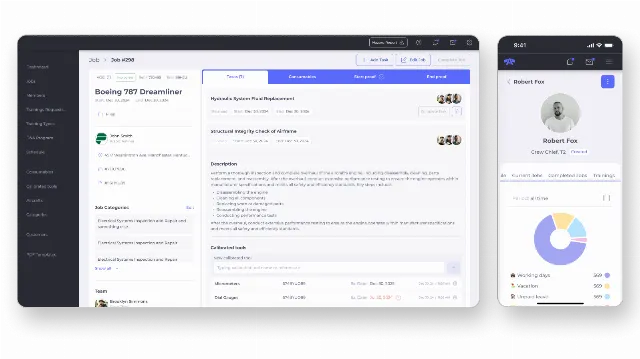
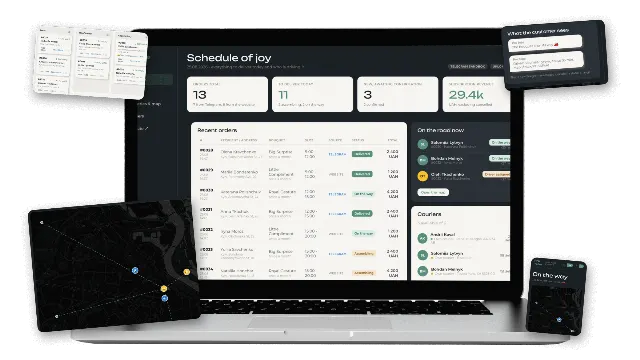
We are a custom software company founded in 2020, and internal business systems are our core work. We have built an ERP for a US aircraft service company used by everyone from technicians to the CEO, a ticket CRM for a telecom support team in France, and an order and courier dispatch CRM for a subscription retail business. Our own team runs every project on an internal board we built ourselves.
Every CRM project starts with a written scope and a fixed quote, runs in milestones with weekly demos, and ends with code and data you own. If you also need operations modules such as warehouse, shifts or compliance, read our guide to custom ERP cost for a 10 to 60 person company. To see how we work and what the first module could be, visit our custom CRM and ERP development page and bring the five daily workarounds your team would like to stop.