 En
En
 Fr
Fr
 De
De
 It
It
 Es
Es
 Uk
Uk
Why do companies outsource software development to Ukraine?
Companies outsource software development to Ukraine mainly for senior engineering talent at rates well below US and UK levels, with good English and strong working-hours overlap with Europe. Ukraine has a large, mature IT services sector that has worked with Western clients for more than two decades.
Ukrainian engineers are known for strong fundamentals in back-end development, complex business systems and mobile apps, and many teams now build AI features with OpenAI, Claude and open models. The trade-off in 2026 is clear and should not be hidden: Ukraine is a country at war, and buyers need to understand how that affects delivery. This guide covers both sides, with typical market ranges rather than promises.
How much does software outsourcing to Ukraine cost compared with other regions?
Typical agency rates for senior engineers in Ukraine in 2026 are roughly $30 to $50 per hour, compared with $100 to $200 or more in the US, $80 to $160 in the UK and Western Europe, $45 to $90 in Poland and $35 to $80 in Latin America. These are typical ranges we see in the market in 2026, not quotes from any specific vendor.
| Factor | Ukraine | United States | UK | Poland | Latin America |
|---|---|---|---|---|---|
| Typical agency rate (2026 market range) | $30 - $50/h (senior) | $100 - $200+/h | $80 - $160/h | $45 - $90/h | $35 - $80/h |
| Time zone (standard time) | UTC+2 (UTC+3 summer) | UTC-5 to UTC-8 | UTC+0 (UTC+1 summer) | UTC+1 (UTC+2 summer) | Mostly UTC-3 to UTC-6 |
| Overlap with US East Coast | 3-4 hours with shifted schedule | Full | 3-4 hours | 2-4 hours | Full or near full |
| Overlap with UK | Near full (2 hours ahead) | 3-4 hours | Full | Near full (1 hour ahead) | 2-5 hours |
| Legal framework | Non-EU, contracts often under foreign law | Domestic | Domestic | EU, GDPR native | Varies by country |
| Main risk | War-related disruption: power, connectivity, staff availability | Cost | Cost | Rising rates, talent competition | Hiring competition, varying English levels |
A lower rate only matters if productivity is comparable. Judge vendors on the output per week, not the hourly figure, and compare prices for the same written scope. Here is what typical projects cost with us as a Ukrainian agency, next to a typical US or UK agency quote for the same scope (roughly 2.5 to 4 times ours):
| Project scope | Lytvynov Production (typical range) | Typical US/UK agency |
|---|---|---|
| Website or simple web app | $10,000 - $15,000 | $25,000 - $60,000 |
| MVP (web or mobile), most projects | $10,000 - $20,000 (up to $50,000) | $30,000 - $80,000 |
| SaaS product | from $10,000 | from $30,000 |
| AI feature, AI agent or AI chatbot | from $10,000 | from $25,000 |
| Full online business (product, admin, payments, integrations) | $35,000 - $70,000 | $125,000 - $200,000 |
| ERP/CRM for a mid-size company | $40,000 - $90,000 | $160,000 - $260,000 |
| Very large multi-platform product | $100,000 and up | $300,000 - $1,000,000 |
For how scope drives the price of a new product, see our guide on MVP development cost.
How much time zone overlap do Ukrainian teams have with the US and UK?
Ukrainian teams have near full working-day overlap with the UK and continental Europe, three to four hours with the US East Coast when the team shifts its schedule, and limited overlap with the US West Coast. Ukraine is on UTC+2 in winter and UTC+3 in summer.
In practice, a US East Coast client and a Ukrainian team usually share the late afternoon in Kyiv, which is morning in New York. That window is enough for a daily standup, demos and decisions, while the rest of the Ukrainian day is focused development. The result is often a useful rhythm: questions asked in the US morning are answered and built by the next US morning. For West Coast clients, one or two overlap hours are realistic, so written communication and async updates matter more.
Is it safe to outsource software development to Ukraine during the war?
Outsourcing to Ukraine during the war carries real risk, but many foreign companies have continued working with Ukrainian teams since 2022 and manage that risk through vendor selection and contract terms. The honest answer is that safety depends much more on the specific vendor's setup than on the country as a whole.
The main war-time risks to delivery are:
- Power outages caused by attacks on energy infrastructure, especially in winter.
- Connectivity loss when power or local networks go down.
- Air raid alerts that interrupt working hours in some regions.
- Staff availability, including relocation and military mobilization of male employees.
- Concentration risk if a whole team works from one city or one office.
None of these are theoretical, and a serious Ukrainian vendor will talk about them openly rather than dismiss them.
How do Ukrainian development teams keep delivery running?
Ukrainian development teams that have kept delivering since 2022 typically rely on remote work, backup power and internet, staff distributed across cities or countries, and processes that avoid single points of failure. When evaluating a vendor, ask them to describe each of these specifically.
Continuity measures worth asking about:
- Remote-first work. Engineers who already work remotely are not tied to a single office that can lose power.
- Backup power at home. Generators, charging stations or battery banks that keep laptops and routers running during outages.
- Backup connectivity. Satellite internet, mobile data from more than one operator, or access to coworking spaces with their own power.
- Geographic distribution. Staff spread across different Ukrainian regions, and sometimes in other countries, so one local outage does not stop the whole team.
- No single point of knowledge. Code review, shared ownership and written documentation so work can move between engineers.
- Infrastructure outside Ukraine. Repositories, CI/CD and production systems hosted with global cloud providers, so nothing critical depends on a Ukrainian data center.
- Transparent communication. A clear rule for how the team reports disruptions and reschedules meetings.
Ask the vendor what happened to their delivery during the worst outage periods, and ask to speak with a current client if possible.
What should the contract include when you outsource to Ukraine?
A contract with a Ukrainian development vendor should clearly cover IP assignment, governing law, dispute resolution, data protection, continuity obligations and exit terms. The goal is that you own everything you paid for and can move it to another team without the vendor's cooperation if you ever need to.
Key clauses to review:
- IP assignment. All code, designs and documentation assigned to you, usually upon payment. The vendor must hold rights from its engineers (employees or contractors) so it can pass them on.
- Client-owned accounts. Repositories, cloud, domains and third-party API keys are in your name from day one.
- Governing law and forum. Many international clients agree on a foreign governing law or international arbitration. Pick something your lawyers are comfortable enforcing.
- Force majeure. War-related force majeure clauses are common in Ukrainian contracts. Make sure the clause requires prompt notice, mitigation and a right for you to terminate if disruption lasts too long.
- Data protection. Ukraine is not in the EU. Clients handling EU personal data typically sign a data processing agreement and use Standard Contractual Clauses for the transfer.
- Exit and handover. Documentation, credentials and a reasonable handover period on termination.
Some Ukrainian IT companies operate under the Diia City legal and tax regime introduced in 2022; others are regular limited liability companies. Either way, check that the entity you sign with is the one that employs or contracts the people doing the work.
What are the hidden costs of outsourcing software development to Ukraine?
The hidden costs of outsourcing to Ukraine are mostly the same as for any offshore team: your own management time, communication overhead, onboarding and the risk of rework if the scope is unclear. The hourly rate is only one part of the total cost.
Items to include in a realistic budget:
- Product owner time on your side. Someone has to answer questions, attend demos and make decisions every week.
- Onboarding. The first two to four weeks are slower while the team learns your domain and codebase.
- Overlap adjustments. Early or late calls for your team if you are on the US West Coast.
- Continuity buffer. A small schedule buffer for outages or staff changes, which a good vendor will discuss openly.
- Legal review. One-time cost for your lawyers to review the contract, data processing terms and IP clauses.
- Payment fees. International bank transfers and currency conversion.
Even with these items, many US and UK companies find the total cost well below an onshore team of similar seniority. The savings disappear when scope is vague, so get a written scope and a fixed quote after a short scoping call before a large commitment.
What kind of projects fit a Ukrainian development team best?
Ukrainian development teams are a strong fit for long-running product work: SaaS platforms, custom business systems such as ERP and CRM, marketplaces, mobile apps and AI features built into existing products. These projects reward stable, senior engineers who stay with the codebase over time.
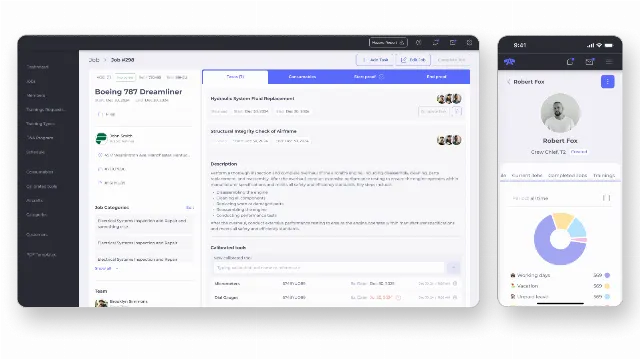
Examples from our own work as a Ukrainian agency: a custom ERP system for a US aircraft service company, built over six months on Symfony/PHP, React, SQL and Mercure, covering orders, service scheduling, staff shifts, warehouse and compliance; Ritoria, a Symfony self-publishing platform for a UK startup that ran in production on AWS for two and a half years with real payouts; and a sports events calendar platform for a UK-based sports tech company that aggregates fixtures from hundreds of feeds. PHP/Symfony is our core back-end stack, which is why we also offer a dedicated Symfony development team.
How do you choose a software development company in Ukraine?
Choose a Ukrainian software development company the same way you would choose any vendor, with extra attention to continuity planning and contract terms. Shortlist two or three, hold a short scoping call with each, start with a small first milestone, and compare how each team communicates and delivers in practice.
A short checklist:
- Case studies with technical detail and, ideally, clients in your country.
- The named senior engineer or lead who will be on your project.
- A concrete continuity plan, as described above.
- Code, infrastructure and credentials in your accounts from the first week.
- A contract with IP assignment, clear governing law and an exit clause.
- Enough overlap hours for your team's rhythm.
- Public ratings on marketplaces or review platforms.
If the project involves AI, add the questions from our guide on how to choose an AI development company.
How we work with US and UK clients from Ukraine
Lytvynov Production is a web, mobile and AI development agency from Ukraine, legal entity LLC "Lytvynov Production", working remotely with startups and B2B companies in the US and Europe in English, French and Ukrainian. Our main stack is PHP/Symfony, React, Vue and Angular, React Native and Flutter, with OpenAI and Claude APIs for AI features. Senior engineers run delivery and use AI coding agents internally to speed up routine work. We hold a 5.0 rating with 100% Job Success on Upwork.
We give a fixed quote after a short scoping call, then work in fixed-scope milestones or as a dedicated team. Ask us every continuity and contract question in this guide before you sign anything. Contact us to discuss your project, or see our SaaS development service if you are building a subscription product.