 En
En
 Fr
Fr
 De
De
 It
It
 Es
Es
 Uk
Uk
What do React development services include?
React development services include everything needed to put a React interface in production: UX and UI design, component architecture, state and data fetching, integration with the back end, testing, performance work, deployment and maintenance. At Lytvynov Production the same team usually builds the API and the database behind the React app as well, because most front-end problems start as back-end or data problems.
A typical React engagement with us covers:
- React web apps with Vite for logged-in products: dashboards, SaaS workspaces, CRMs, back offices and internal tools.
- Next.js for public pages that must rank and load fast: marketing sites, catalogs, marketplaces, public profiles and documentation.
- React Native apps for iOS and Android when mobile is part of the product, sharing types and business logic with the web app.
- Back end: PHP/Symfony for business-heavy products, or Node.js with Express when the product is JavaScript end to end.
- AI features: streaming chat interfaces, generation and review screens, and assistants built on the OpenAI or Anthropic Claude APIs.
- Delivery: CI/CD, Docker-based environments, error monitoring, analytics and app store releases.
Why choose React for a SaaS product or an AI app?
React is the default choice for SaaS and AI products because it has the largest ecosystem of UI libraries, the biggest hiring pool and a direct path to mobile through React Native. For a buyer, that means lower risk: when your product grows, you can hire React engineers in any market, and your code will not depend on one agency.
For AI-heavy apps, React handles the interface patterns that LLM products need: streaming responses token by token, showing sources next to an answer, letting a user edit and regenerate a draft, and approving or rejecting an action an agent proposes. Those patterns are easy to build badly. We treat them as product design problems first: what the user sees while the model is thinking, what happens when the answer is wrong, and how the user corrects it. See generative AI development for the model side of this work.
React, Next.js or React Native: which one do you need?
Most products need React for the logged-in app, Next.js only if public pages matter for search, and React Native only if users need a mobile app rather than a mobile-friendly website. The table below is how we usually decide in scoping.
| Your situation | What we recommend | Why |
|---|---|---|
| Product lives behind a login (SaaS, CRM, admin) | React with Vite | Simple to build, host and test; no server rendering needed |
| Public pages must rank in Google or load fast | Next.js | Server rendering and static generation for SEO and speed |
| Marketplace or platform with public catalog and private workspace | Next.js for public pages, React app for the workspace | Each part uses the model that suits it |
| Users need push notifications, camera, offline use or app store presence | React Native for iOS and Android | One codebase for both platforms, shared logic with web |
| Mobile users only need to read and fill forms | Responsive React web app | Cheaper and faster than native apps; add mobile later |
If you are still at the idea stage, start with the smallest option that proves the product. Our MVP development service covers how we cut scope before the build.
Which React projects have we built?
We have built React and React Native products for US clients, from AI consumer apps to internal enterprise platforms. Two examples that show the range:
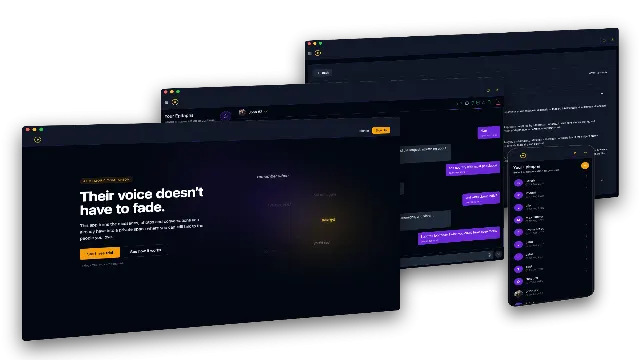
- AI Grief Companion for a US startup: a web client in React and Vite, iOS and Android apps in React Native, and a Node and Express API on PostgreSQL for accounts, subscriptions and message storage. Behind it runs an AI platform with chat-history ingestion from ten export formats, LoRA training of a persona model and RAG memory. The chat keeps working at every stage of training, so the interface never waits for the slowest part of the pipeline.
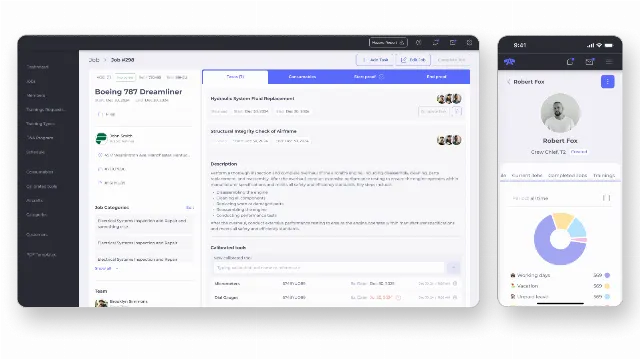
- Custom ERP for a US aircraft service company: built over six months with Symfony/PHP, React, SQL and Mercure for real-time updates. The platform brings client profiles, orders, aircraft service scheduling, shift management with calendar integrations, warehouse inventory and compliance tracking into one application used by everyone from ground staff to the CEO.
The first project is a React Native plus React product with a Node back end and heavy AI; the second is a React front end on a Symfony back end with real-time data. Most of our React work sits between these two.
How do we structure a React codebase that lasts?
A React codebase lasts when the rules are decided in week one and enforced by tooling, not by memory. Most React projects that become hard to change did not fail because of React; they failed because every developer fetched data, handled errors and built forms in a different way.
The defaults we set on every React project:
- TypeScript everywhere, with API types generated from the back end so the front end breaks at build time, not in production.
- Server state in one place (TanStack Query or the Next.js data layer), and local UI state kept local. No global store for data that belongs to the server.
- A small design system: buttons, inputs, tables, modals and empty states as shared components, built from the Figma design.
- Forms with schema validation shared between client and server where possible.
- Tests where they pay: unit tests for business logic, end-to-end tests for the critical user flows, not snapshots of every component.
- Performance budgets: bundle size and Core Web Vitals checked in CI for public pages.
- Accessibility basics: keyboard navigation, labels and color contrast checked before release.
We use AI coding agents internally for routine work such as scaffolding, tests and refactors, with senior engineers reviewing every change. That is a large part of how we keep React timelines short without lowering the bar.
How do React and the back end work together?
React is only as good as the API behind it, so we design the API and the screens together. On Symfony we expose a typed REST or GraphQL API with clear error formats, pagination and permissions checked on the server; on Node we do the same with Express or a similar framework. Real-time features such as live boards, notifications or chat use Mercure, WebSockets or server-sent events, depending on the stack.
Keeping both sides in one team removes the most common source of delay in React projects: front-end developers waiting for endpoints, or building against an API that changes under them. If your back end is PHP, see our Symfony development service; if you are building a subscription product, see SaaS development.
Can we hire React developers as a dedicated team?
Yes. If you need ongoing React capacity rather than a fixed project, we work as a dedicated team: a React engineer, a back-end engineer and a lead, with React Native, QA and design added as the roadmap needs them. The team works in your repositories and tools, demos every week and reports progress against your roadmap, not hours.
Compared with hiring individual React developers for hire on a freelance platform, a team gives you code review, continuity when someone is away, and one person accountable for delivery. Compared with in-house hiring, you can start in weeks rather than months and scale down after a release. The details of how that engagement works are on our dedicated development team page.
How much does React development cost?
React development cost depends on scope, platforms and integrations far more than on the framework. With us, a React web app starts from $10,000 and a fixed quote follows a short scoping call. For ranges by project type, run costs and a comparison with US and UK agencies, read our guide to React development cost.
How we work on React projects
We start with a short scoping call about the product, the users and what already exists. From that we agree the platforms (React, Next.js, React Native), the back end, the integrations and the first milestone, and you get a fixed quote. The build runs in milestones with a demo every week, in your repositories and cloud accounts, with documentation and a handover plan from the start. After launch we continue as your team or hand over to your in-house developers.
Tell us what you are building on our contact page, or describe the scope in our project estimate form.