 En
En
 Fr
Fr
 De
De
 It
It
 Es
Es
 Uk
Uk
What do our Node.js development services include?
Node.js development services with us cover TypeScript APIs, real-time features, AI streaming back ends and the integrations around them, built by the same team that builds the React or React Native app on top. Our main back-end stack is PHP/Symfony; we choose Node.js when the product is JavaScript end to end, when real-time behavior is at its core, or when the back end mostly orchestrates AI model calls.
A typical Node.js engagement covers:
- REST or GraphQL APIs in TypeScript with Express or a similar framework, schema validation at the boundary and typed clients for the front end.
- Real-time features: chat, live boards, notifications and collaborative screens over websockets or server-sent events.
- AI back ends: streaming OpenAI or Claude responses, tool calls for AI agents, and job queues for long-running AI work.
- Integrations: payments, in-app purchases, email, cloud storage and partner APIs.
- Proxies and gateways in front of third-party APIs, to hide keys, cache results and enforce limits.
- Delivery: Docker, CI/CD, monitoring and cloud deployment.
When is Node.js the right back end?
Node.js is the right back end when one language across the whole product matters, when many connections stay open at once, or when the server mostly waits on other services. Its event loop handles many concurrent connections efficiently, which suits chat, live updates and streaming. It is a weaker fit for CPU-heavy work, which should run in workers or a separate service.
| Your situation | What we recommend | Why |
|---|---|---|
| JavaScript team, web and mobile apps sharing logic | Node.js with TypeScript | One language and shared types from database to screen |
| Real-time product: chat, live boards, tracking | Node.js with websockets | Efficient with many open connections |
| Back end mostly calls AI models and streams answers | Node.js | Streaming and concurrent I/O are natural fits |
| Complex business rules, many roles, large back office | PHP/Symfony | Explicit architecture and mature admin tooling |
| Machine learning, model training, data pipelines | Python service | Best ecosystem for ML; Node.js or PHP calls it |
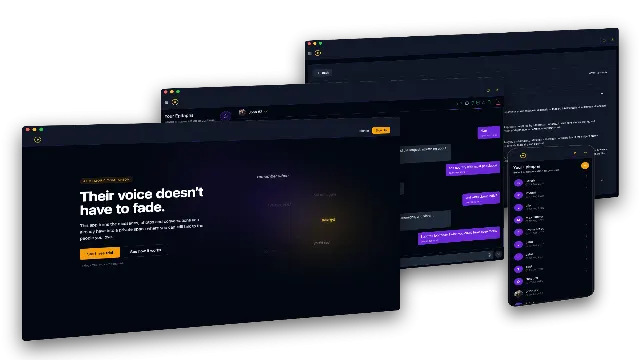
Many of our products combine these. The AI Grief Companion uses a Node.js API for the product and a Python platform for the AI pipeline; the aircraft service ERP uses Symfony. If your product is business-rule heavy, see Symfony development.
How do you build real-time features on Node.js?
Real-time features on Node.js are built on websockets or server-sent events, with a shared message channel between server instances so updates reach every connected user. The hard parts are not the protocol: they are reconnects, missed messages, permissions on every channel and what the screen shows while data is in flight.
Our defaults:
- Server-sent events for one-way updates such as notifications and AI streaming; websockets when the client also sends a stream of events.
- Redis or a similar broker between instances, so the app scales beyond one server.
- Authorization per channel, checked on subscribe, not only on login.
- Resumable state: on reconnect, the client fetches what it missed instead of trusting the stream.
- Back-pressure and limits for slow clients and noisy users.
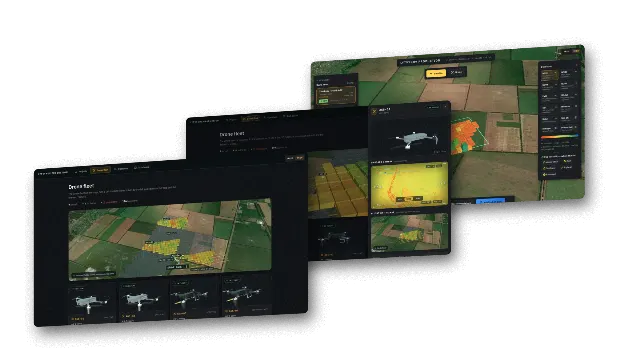
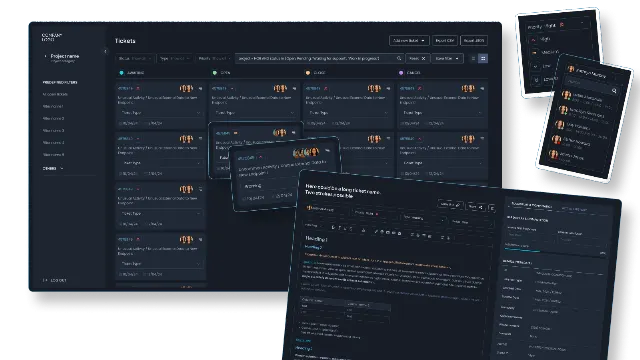
Our drone swarm R&D prototype shows the front of this pattern: a browser ground control station in React and TypeScript with a live 3D fleet map, a self-running task board and a small Node.js proxy for the Sentinel-2 satellite API. The task management system we built for a telecom support team in France, on React, Next.js and Node.js, ingests third-party alarms and sends automated notifications as tickets move.
How do you stream AI responses with Node.js?
Streaming AI responses means the server forwards the model's answer to the user token by token instead of waiting for the full reply. On Node.js the server calls the OpenAI or Anthropic Claude API in streaming mode and pushes each chunk to the browser over server-sent events or a websocket.
What we build around the stream:
- Authentication and per-user limits before any model call, so token costs stay predictable.
- Cancellation: when the user closes the tab or presses stop, the model call stops too.
- Logging of prompts, results and token usage for review and cost reports.
- Fallbacks for slow or failing providers, and clear messages in the interface instead of a frozen spinner.
- Tool calls for AI agents, executed on the server against your own permission model. See AI agent development.
In the AI Grief Companion for a US startup, the Node.js 22 and Express API on PostgreSQL handles accounts, subscriptions with Stripe and Apple in-app purchases, and message storage, while a websocket carries each reply from the AI platform back to the web and mobile apps as it lands. The chat keeps working at every stage of model training, so the interface never waits for the slowest part of the pipeline.
How do we structure a Node.js codebase that lasts?
A Node.js codebase lasts when structure and rules are set in week one. JavaScript gives a team many ways to do the same thing, so we decide them early and let tooling enforce them.
- TypeScript in strict mode, with types shared with React and React Native clients.
- Validation at the edge: every request body and external response checked against a schema.
- Business logic out of route handlers, in plain modules that can be tested without HTTP.
- A typed database layer with versioned migrations on PostgreSQL.
- Queues for slow work: emails, imports and AI jobs run outside the request.
- Tests where they pay: business rules and the critical end-to-end flows.
- Dependency hygiene: a short list of well-maintained packages, updated on a schedule.
We use AI coding agents for routine work such as scaffolding, tests and refactors, with senior engineers reviewing every change.
How much does Node.js development cost?
Node.js development cost depends on scope, platforms and integrations. As orientation, with us a web app or API typically costs $10,000 to $15,000, an MVP $10,000 to $50,000 with most at $10,000 to $20,000, and a product with web and mobile apps $20,000 to $50,000. Complex AI products with custom models land at $60,000 to $150,000. For details on AI build and run costs see our guide to AI app development cost.
How we work on Node.js projects
We start with a short scoping call about the product, the users and what already exists, then agree the stack, the integrations and the first milestone with a fixed quote. The build runs in milestones with a weekly demo, in your repositories and cloud accounts. After launch we continue as your team or hand over to your developers with documentation. The front-end side of the same work is on our React development page.
Tell us what you are building on our contact page, or describe the scope in our project estimate form.