
Why move from Prom.ua to your own online store?
A marketplace store brings first sales quickly, but over time the business hits things it does not control: how product pages look, how Google sees the business outside the marketplace, what each order costs and who owns customer data. Your own online store instead of Prom.ua gives those back: a catalog structured around real demand, your own texts and photos, your own Google Shopping feed and pages AI assistants can read and cite.
Lytvynov Production moves businesses from a store on Prom.ua or another marketplace to their own site. We do it so that old links and history are kept, and the marketplace can stay on as an extra sales channel if you want.
What does Prom.ua charge, and when should you keep the marketplace?
Prom.ua charges a yearly plan plus a commission on orders. According to prom.ua/how_to_order, checked on 19 November 2026:
- Plan: new sellers who verify as a sole proprietor or company can take a special offer at UAH 1,900 per year (valid for 365 days, for sales from 7 August to 31 December 2026). Other plans depend on the plan and product limit and are not priced on that page.
- Commission for a site on a Prom subdomain: a single commission from 4.2% of the product price, depending on category; "Economy" mode is half that, from 2.1%; promotion modes cost more.
- Prom site on your own domain: UAH 10 per order including VAT (except orders paid with Prom payment and "Pay in installments").
Check the exact commission for your category in the table on Prom's site. We do not quote Rozetka commissions here because we have not checked them on an official page.
Keep the marketplace if it brings a noticeable share of orders you will not get from your own site in the first months. You need your own site when you want to build brand recognition, get traffic from Google and AI search directly, manage prices and promotions from one place, and not depend on one platform's rules.
Case study: how we moved MELITA from Prom.ua to its own store
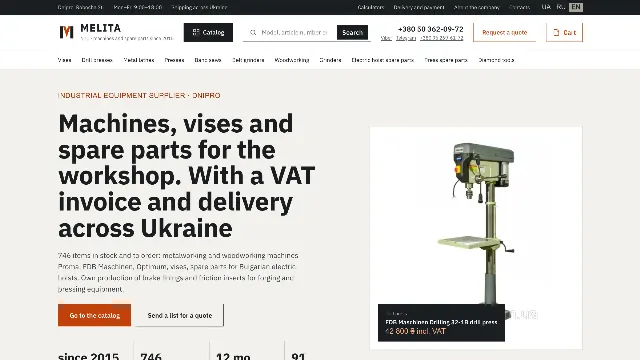
MELITA is a B2B supplier from Dnipro: machine tools, vises, spare parts for Bulgarian electric hoists and presses, and friction linings it makes itself for old crank presses. For years the business lived on a Prom.ua store: descriptions machine-translated from Russian, watermarked photos, duplicate product cards competing with each other, and almost no visibility in Google outside the marketplace.
What we did:
- A new store on Medusa 2 with a Next.js 16 storefront in three languages: Ukrainian, Russian and English. Stack: TypeScript, PostgreSQL, Redis, Docker, Nginx, Cloudflare, and Python for data and image pipelines.
- Migrated about 750 products, and every old product and category URL from the Prom store answers with a 301 to its new page.
- Rebuilt the catalog into 64 category pages sized to real Google demand. Before writing a single category we pulled competitors' keywords and real monthly volumes from Google Keyword Planner. Presses, sheet benders, metal milling, grinders, jointers and table saws got their own pages with a search-written title and intro, a buying guide, buyer questions and a comparison table generated from product specs.
- Fixed the texts: several passes removed machine-translation defects from about 690 Ukrainian descriptions, then the Russian and English versions were rebuilt from the corrected text.
- Official specs and photos for 188 products came from FDB Maschinen, PROMA and Stürmer (Optimum, Metallkraft, Holzstar) sites, accepted only on an exact model or article match.
- Google Shopping: a Google Merchant Center feed with sale prices and sale end dates; old watermarked photos were cleaned for the feed.
- Supplier price-list import: the owner uploads an Excel file, sees every price, stock and promotion change before it goes live, applies it in one click and can roll it back.
- Useful pages around the catalog: twelve engineering calculators (metal and rebar weight, spindle speed and feed, tap drill size, hoist selection) and ten reference articles linked to the products they discuss.
The result: the store was opened to search engines in October 2026, and the main catalog pages entered Google's index within two days. Mobile Lighthouse scores are 94-100 with zero layout shift. 737 products are listed in Google Merchant Center. Full write-up in the MELITA case study.
What moves from Prom.ua to your own site?
Moving a store off Prom.ua is not copying product cards; it is a chance to fix what was holding sales back. We work on these parts:
- Catalog and structure. Products, categories, specs and variants. We build categories around what people actually search for, not only the marketplace's tree.
- Texts and translations. We fix machine translation, remove duplicates, and add buying guides and answers to buyer questions.
- Photos. We use official manufacturer photos where the model matches exactly and prepare watermark-free images for Google.
- Old links. Every old page gets a 301 redirect to its new page to keep links and history. Redirects are possible for URLs you control; we check this at the start.
- SEO and structured data. Product and organization markup with shipping and return terms, sitemaps, link previews.
- Prices and stock. Import from the supplier's Excel or your accounting system, with a preview of changes.
Google Shopping and AI search for your own store
Your own site gives you two channels a marketplace store does not control. The first is Google Shopping: a Merchant Center feed with current prices, promotions and clean photos. The second is AI assistants, which increasingly answer questions like "which machine should I buy": for MELITA we added llms.txt, Markdown copies of products and a public MCP endpoint so AI assistants can read and cite the catalog, plus a generated 1200x630 preview for every category, article and calculator so links shared in Telegram or Viber look like the brand.
Should you keep Prom.ua as an extra channel?
Often, yes. The marketplace brings buyers who search there, while your own site becomes the base: this is where you manage prices, texts and promotions, and from here you update other channels. If orders come from several places, it helps to collect them in one CRM; we compare off-the-shelf and custom options in our guide custom CRM vs off-the-shelf CRM in Ukraine.
How much does the move cost and how long does it take?
The minimum project size at Lytvynov Production is $10,000. The price depends on the number of products and languages, the amount of work on texts and photos, integrations with suppliers and accounting, and whether you need calculators, articles and a Google Shopping feed. The timeline depends on the same factors, so we give it together with a fixed quote after a short scoping call. You can get a first range through our project estimate form.
If you need an internal system for orders, stock or delivery as well as a store, see our custom CRM and ERP development and Next.js development.
Next step
Send us a link to your store on Prom.ua or another marketplace and tell us how many orders it brings and what is not working. On a short call we will tell you whether it is worth moving now, what we will migrate, how we will keep your links, and what it will cost. Book a consultation.