En
 Fr
 De
 It
 Es
 Uk
What are AI agents for business?
AI agents for business are software that uses a language model to decide the next step and then acts through your tools: the CRM, helpdesk, ERP, email, calendar or database. Useful examples include lead research in sales, ticket triage in support, job dispatch and document intake in operations, invoice matching in finance, candidate screening in HR and review helpers in engineering. With Lytvynov Production a custom agent for one workflow starts from $10,000.
The examples below are grouped by department. For each one we list what the agent reads, what it changes and how much autonomy it should get on day one. They are drawn from systems we have built, from our own internal tooling and from what companies of 10 to 200 people bring to scoping calls.
How do you read these examples?
Every agent below is rated on two things that drive both cost and risk: what it can change, and how much freedom it has.
| Level | What the agent does | Typical approval |
|---|---|---|
| Read | Searches, summarizes, drafts | None needed, a person uses the output |
| Write with approval | Prepares a change, a person confirms | Every action at first |
| Write on its own | Acts without confirmation | Only for reversible, measured categories |
Most first agents should sit at the first or second level. Autonomy is something an agent earns after its error rate is measured on real cases.
AI agent examples in sales
1. Lead research and qualification agent
Reads a new inbound lead, looks up the company website and public profiles, checks your CRM for previous contact, scores the lead against your ideal customer profile and writes a short brief for the salesperson. Level: read, plus writing a note in the CRM. Tools: CRM, web search, company data APIs.
2. Proposal drafting agent
Takes call notes and the scope discussed, pulls matching case descriptions and price ranges from your internal library, and drafts a proposal in your template for a person to edit. Level: read and draft. The main build effort is the library and the template, not the model.
3. CRM hygiene agent
Finds duplicate contacts, missing fields and deals with no activity for 30 days, proposes merges and fills gaps from emails and notes. Level: write with approval. A quiet, high-value agent, because sales reports are only as good as the CRM data behind them.
AI agent examples in customer support
4. Ticket triage agent
Classifies incoming emails, chat messages and form submissions, adds customer and order context from your systems, sets priority and routes to the right queue. Level: write on its own for routing, which is reversible. We built ticket processing of this kind into a task and ticket system for a telecom support company in France, where tickets arrive both from people and from third-party alarm systems.
5. Order and account lookup agent
Answers "where is my order", "change my delivery date" or "resend my invoice" by calling your order system and acting within fixed limits. Level: write on its own within limits, with handover to a person outside them. Our guide on AI agents for customer service compares off-the-shelf tools with custom agents for this case.
6. Knowledge base answer agent
Answers product and policy questions from your documentation using retrieval (RAG), cites the source and hands over when confidence is low. Level: read. The quality depends on the documentation more than the model.
AI agent examples in operations
7. Job dispatch agent
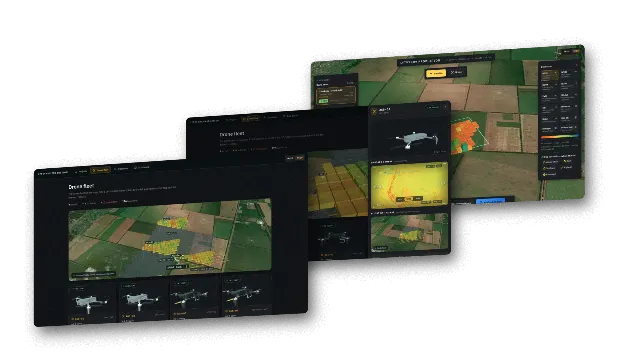
Assigns incoming jobs to the right crew, technician or courier based on location, skills, availability and priority, and updates the schedule. Level: write with approval at first. In our drone swarm R&D project the fleet picks up tasks from a queue as soon as an aircraft frees up, without a dispatcher, which works because the task rules are explicit and the operator sees every assignment on one map.
8. Document intake agent
Reads purchase orders, delivery notes, certificates or applications, extracts the fields, checks them against your records and creates draft entries in the ERP. Level: write with approval. One of the most reliable first agents, because each document can be checked against a known structure.
9. Compliance reminder agent
Watches expiry dates for certificates, inspections and licences, gathers the missing documents by email and prepares the renewal package for a person. Level: read and draft, write for reminders. Valuable in regulated industries where a missed date stops work.
AI agent examples in finance
10. Invoice matching agent
Matches incoming supplier invoices against purchase orders and delivery records, flags mismatches in price or quantity, and prepares approved invoices for payment. Level: write with approval, permanently for payments.
11. Collections follow-up agent
Checks which invoices are overdue, drafts reminders in the right tone for each customer's history, and logs replies and promised dates in the CRM. Level: draft, with sending on its own only for the first polite reminder.
12. Expense review agent
Reads receipts, checks them against the expense policy, categorizes them and sends exceptions to a manager. Level: write on its own for categorization, approval for exceptions.
AI agent examples in HR and internal operations
13. Candidate screening assistant
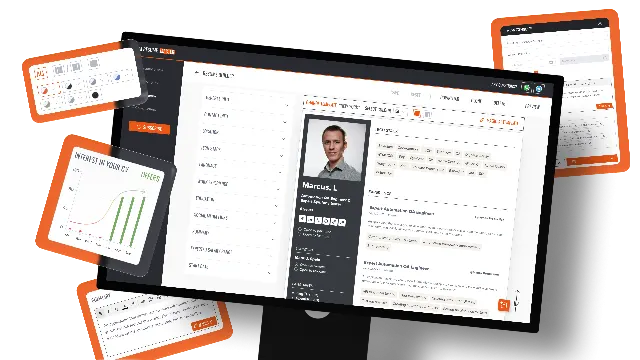
Reads applications against the role's must-have criteria, writes a structured summary per candidate and drafts interview questions. Level: read and draft. A person decides; automated rejection carries legal and fairness risks in many jurisdictions. Our own AI SaaS for resume writing, used by 50,000 people a month, taught us how varied real CVs are and why the summary format matters more than the model.
14. Internal knowledge assistant
Answers employee questions about policies, processes and past projects from wikis, documents and tickets, with links to sources and respect for each person's access rights. Level: read. Permissions are the hard part: the agent must never show a document the person could not open themselves.
AI agent examples in engineering
15. Engineering workflow agent
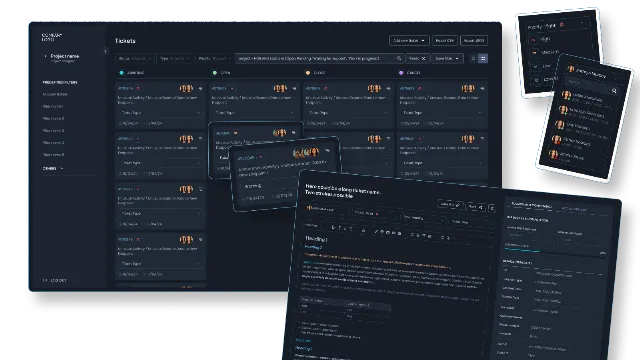
Picks up tasks from the project board, reads the linked specification, prepares code changes, runs tests and posts results back for a human review. Level: write with approval through the normal code review process. We run agents like this internally every day: our engineers and AI coding agents work through an MCP server on top of our own project board. Our guide what is an MCP server explains how that tool layer works.
How do the 15 examples compare?
| # | Agent | Department | Day-one level | Typical first build with us |
|---|---|---|---|---|
| 1 | Lead research and qualification | Sales | Read | from $10,000 |
| 2 | Proposal drafting | Sales | Draft | from $10,000 |
| 3 | CRM hygiene | Sales | Write with approval | from $10,000 |
| 4 | Ticket triage | Support | Write on its own (routing) | from $10,000 |
| 5 | Order and account lookup | Support | Write within limits | $10,000 to $30,000 |
| 6 | Knowledge base answers | Support | Read | from $10,000 |
| 7 | Job dispatch | Operations | Write with approval | $10,000 to $30,000 |
| 8 | Document intake | Operations | Write with approval | from $10,000 |
| 9 | Compliance reminders | Operations | Draft | from $10,000 |
| 10 | Invoice matching | Finance | Write with approval | $10,000 to $30,000 |
| 11 | Collections follow-up | Finance | Draft | from $10,000 |
| 12 | Expense review | Finance | Write on its own (categories) | from $10,000 |
| 13 | Candidate screening | HR | Draft | from $10,000 |
| 14 | Internal knowledge assistant | Company-wide | Read | from $10,000 |
| 15 | Engineering workflow | Engineering | Write with approval | from $10,000 |
The range widens with the number of systems an agent touches and the amount of evaluation needed before it can act. A typical US or UK agency quotes roughly 2.5 to 4 times more for the same scope. Our guide on AI agent development cost breaks down build and monthly running costs.
How do you choose your first AI agent?
Pick the workflow with the highest volume, clear written rules and cheap mistakes, then start it in read or approval mode. Four questions help:
- How many times a week does this task happen, and how long does it take a person?
- Is there a written procedure, or does it live in one person's head?
- What does a mistake cost, and how fast would someone notice?
- Can the agent reach the data through an API, or does it need a person to copy it?
If the steps are predictable, a fixed workflow with one model step is often enough and cheaper than an agent. Our guide on what an AI automation agency does covers that simpler path.
How we build AI agents for business
We build custom AI agents with scoped permissions, human approval for risky actions, MCP servers or tool layers for system access, full action logs and an evaluation set built from your real cases. A first agent usually covers one workflow over 6 to 12 weeks, and we give a fixed quote after a short scoping call.
To see how we approach tools, permissions and evaluation, visit our AI agent development page and bring one workflow from the list above that your team would like to hand over.