En
 Fr
 De
 It
 Es
 Uk
What does an AI automation agency actually do?
An AI automation agency takes a repetitive business process, maps it, decides which steps need a language model and which stay plain rules, builds the workflow inside the tools you already use, and keeps a person in the loop for anything risky. With Lytvynov Production a first automated process starts from $10,000 and usually goes live in 4 to 8 weeks. Our AI Sprint is a fixed $10,000 for 4 weeks of work by a senior team.
The term covers very different businesses. Some agencies connect SaaS tools with no-code platforms, some sell strategy and slide decks, and some are engineering teams that write and run code. A large share of online content about "AI automation agencies" is aimed at people who want to start one, which makes it hard for a buyer to know what a reasonable offer looks like. This guide is for the buyer.
What are the three types of AI automation agency?
AI automation agencies fall into three groups, and the difference shows up in what you own at the end of the project.
| Type | What they build | Good for | Watch out for |
|---|---|---|---|
| No-code automation shop | Workflows in n8n, Zapier or Make, chatbot builders, prompt templates | Low-volume flows between popular SaaS tools, quick experiments | Per-task fees at scale, fragile error handling, workflows living in the agency's account |
| AI consultancy | Assessments, use-case scoring, roadmaps, vendor selection | Large organisations deciding where to start | A recommendation without anyone responsible for building it |
| Engineering team | Integrations, a processing service, review screens, monitoring, as code in your repositories | Workflows inside your CRM, ERP or own database, higher volumes, audit requirements | Higher entry price than a single no-code workflow |
We are in the third group: a software development company that builds AI automation as part of the systems it already builds, such as CRMs, ERPs and SaaS products. That is also our bias, so weigh our view accordingly. For a few hundred tasks a month between Gmail and a spreadsheet, a no-code shop is often the right call.
What does an AI automation project look like week by week?
A well-run AI automation project starts with one process and moves through five stages in 6 to 12 weeks.
- Process review (1 to 2 weeks): the agency maps how the work is done today, measures volume and time per item, collects real samples such as emails, invoices or tickets, and splits the steps into rules, model calls and human decisions. You get a fixed quote and an expected savings figure.
- Build (3 to 5 weeks): integrations with your systems, the processing logic, a review screen for staff, logging and cost limits.
- Shadow mode (1 to 2 weeks): the automation runs next to your team without acting, so you can compare its output with what people did.
- Live with review (2 to 4 weeks): the automation acts and a person confirms. Confirmation is removed only for categories where accuracy has been measured.
- Next process: integrations and the review screen are reused, so the second workflow is faster and cheaper.
If an agency proposes to skip the process review or shadow mode, ask how they will know the automation is correct before it touches real customers or records.
What should an AI automation agency deliver?
At the end of a project you should have working software and the means to keep it working. This is the list we use as our own definition of done:
- The automation running in production inside your tools, with credentials in your accounts.
- Code or workflow definitions in your repositories, with a short architecture note.
- Prompts and model settings under version control.
- A test set of real examples with expected results, and a script that scores the automation on it.
- A review screen where staff see pending items, the automation's decision and the reason.
- Monitoring: items processed, share handled without a person, error rate, cost per item.
- Documentation another team could follow.
The test set matters most and is skipped most often. Without it nobody can tell whether a new prompt or a model upgrade made things better or worse.
How do AI automation agencies price their work?
Agencies price AI automation in four ways: per workflow, per project, per sprint and as a monthly retainer. The table shows how each works and our own ranges.
| Pricing model | How it works | Market practice (2026) | With Lytvynov Production |
|---|---|---|---|
| Per workflow | Fixed fee for one no-code or simple workflow | Often a few thousand dollars, plus platform fees | Not offered below our $10,000 minimum |
| Per project | Fixed quote for one process end to end | Varies widely with integrations and volume | From $10,000, fixed quote after a short scoping call |
| Per sprint | Fixed time box with a fixed price | Less common | AI Sprint: $10,000 fixed for 4 weeks |
| Monthly retainer | Ongoing improvements, monitoring, new workflows | Common for no-code shops | Monthly plan or dedicated team after launch |
A typical US or UK agency quotes roughly 2.5 to 4 times our ranges for the same scope. Running costs come on top for every model: model usage, hosting and any platform subscriptions. For a single back-office workflow, model usage is often under a few hundred dollars a month; our AI agent development cost guide shows how to estimate token spend on your own volumes.
Which processes should an AI automation agency start with?
Start where volume is high, the rules are mostly clear and a mistake is cheap to catch. These are the first candidates we see most often:
- Document intake: invoices, purchase orders, applications and contracts read into structured records for a quick human confirmation. Our guide to AI invoice and document processing covers this case in detail.
- Email and ticket triage: incoming requests classified, enriched with data from your systems and routed to the right person.
- Order and dispatch flows: an order gets a status, a responsible person or courier and customer notifications without phone calls.
- Data sync: records created in one system appear correctly in the others, with gaps filled from free-text notes.
- Recurring reports: weekly summaries assembled from your data with a short drafted commentary.
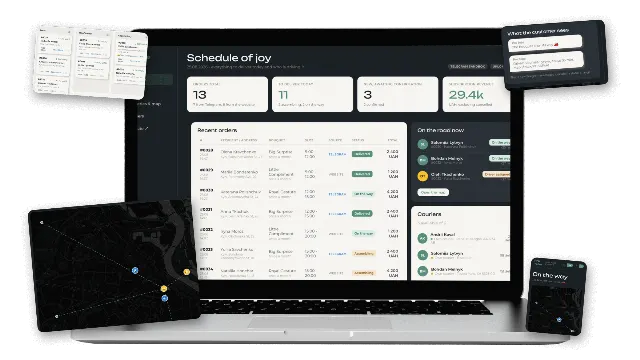
As an example, for a subscription retail business we built an order board with courier dispatch through a delivery API and customer notifications in Telegram, where every integration had a sandbox implementation behind the same interface so the whole flow could be demonstrated before production credentials existed. Our guide on which business processes to automate with AI first has a scoring method for ranking your own candidates.
How do you vet an AI automation agency?
Ask questions that only a team that has shipped automation to production can answer well:
- Show us an automation you built that runs in production today. What share of items does it handle without a person?
- How do you measure accuracy before and after launch?
- What happens when the model returns something wrong or malformed?
- Where will the code, prompts and credentials live?
- What will this cost to run each month at our volume?
- Which steps would you keep as plain rules rather than AI, and why?
- Who maintains it after launch, and what does that cost?
Good answers are specific and come with numbers. Answers that are mostly about the latest model, or that promise full autonomy from day one, are a warning sign.
When is a custom AI agent a better fit than an automation?
When a step needs several judgment calls in a row, such as looking something up, deciding, acting and checking the result, it becomes an AI agent rather than a fixed workflow. Agents cost more to build and test because they choose their own path. Our guide with AI agent examples by department shows where agents earn that extra cost and where a simpler automation is enough.
How we work as an AI automation team
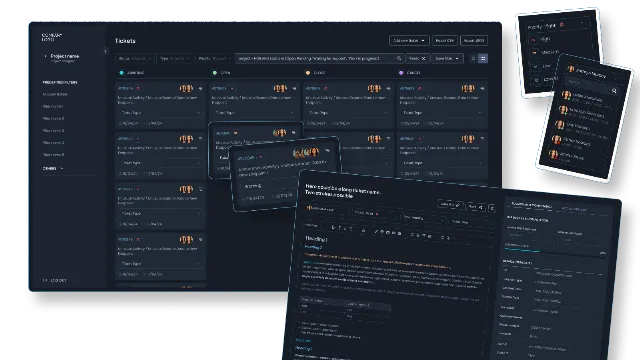
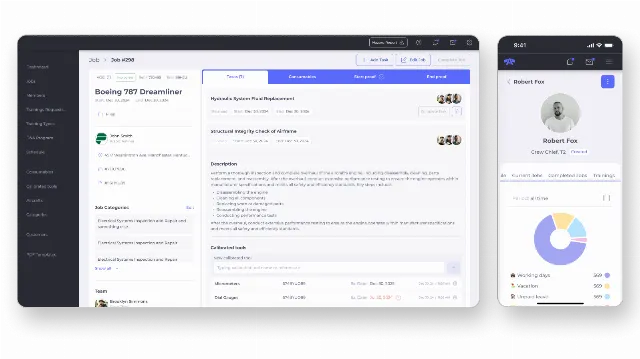
We are a software development company founded in 2020 that builds internal systems, SaaS products and AI features for companies in the US, UK and EU. Our AI automation work lives inside the same kind of systems we build every day: a ticket CRM for a telecom support company in France that takes alarms from third-party systems, an ERP for a US aircraft service company, order and dispatch flows for retail.
Every project starts with a process review, a written scope and a fixed quote. The code is yours, a person reviews anything risky, and accuracy is measured on your real data before the automation acts alone. See our AI automation services for how we build, or bring one process you would like to stop doing by hand to a short scoping call.