En
 Fr
 De
 It
 Es
 Uk
What is an AI voice agent, and do you need a custom one?
An AI voice agent answers or makes phone calls, understands speech, decides what to do and replies in a natural voice, often while looking up or updating data in your systems. Off-the-shelf AI receptionists work well for answering common questions, taking messages and booking into a standard calendar. A custom voice agent pays off when calls must read and write your own CRM, ERP or order system, follow your business rules, or run at volumes where per-minute platform fees add up.
All-in running costs commonly land at $0.10 to $0.30 per minute of conversation. With Lytvynov Production a custom voice agent starts from $10,000. The rest of this guide helps you decide which of the three routes fits: an AI receptionist app, a voice agent platform or a custom build.
How does an AI voice agent work?
A voice agent runs a loop several times a second: listen, understand, decide, speak. Most production agents in 2026 use one of two designs.
| Design | How it works | Strengths | Weaknesses |
|---|---|---|---|
| Cascade | Speech to text, then a language model with tools, then text to speech, all streamed | Choice of best component for each stage, easy to log and test, any voice and language | Latency adds up across three stages, needs careful tuning |
| Speech to speech | One realtime model takes audio in and returns audio | Lowest latency, natural interruptions and intonation | Fewer voices and providers, harder to inspect, often higher cost per minute |
Around the loop sit the parts that make it a business tool: telephony (a phone number through a provider such as Twilio, or your existing phone system over SIP), turn detection so the agent knows when the caller has finished, tools that read and write your systems, a transfer path to a person, and call logs with transcripts.
We built our own voice agent prototype on the cascade design with the open-source Pipecat framework: streaming speech recognition, a language model with a sales-assistant prompt, and a multilingual voice, speaking Ukrainian. For web calls we estimate its model and voice costs at roughly $0.12 to $0.16 per minute before telephony.
AI receptionist app, voice platform or custom build?
The three routes differ in how much you can connect, how much you control and how cost scales.
| AI receptionist app | Voice agent platform | Custom build | |
|---|---|---|---|
| What it is | A finished product: you configure greetings, FAQs and booking rules | A developer platform: you design the agent, the platform runs the voice loop | Your own service on open-source frameworks and model APIs |
| Setup time | Hours to days | Weeks | 4 to 10 weeks |
| Integrations | Standard calendars, CRMs and messaging | Any API through tool calls, built by your developers | Any system, including legacy and your own database |
| Business rules | Simple | Flexible | Unlimited, tested like any other code |
| Pricing | Monthly plan with a minute allowance | Per-minute platform fee plus model, voice and telephony | Model, voice and telephony costs only, plus hosting |
| Data and voice control | Vendor's | Shared | Yours |
| Good for | Small businesses, missed-call handling, after-hours reception | Teams with developers who want speed | Calls that run core operations, high volume, compliance needs |
A quick test: if you can describe everything the agent must do on a single page of FAQs and booking rules, start with an AI receptionist app. If the description includes phrases like "check the order in our system", "apply our pricing rules" or "update the job and notify the crew", you are past what receptionist apps do well.
What does an AI voice agent cost?
There are two numbers: the cost per minute of conversation and the cost to build. The per-minute cost is the sum of these components:
| Component | What it pays for | Typical share |
|---|---|---|
| Speech to text | Transcribing the caller in real time | Small |
| Language model | Understanding, decisions and tool calls | Small to medium, grows with long prompts and long calls |
| Text to speech | The agent's voice | Often the largest part with premium voices |
| Telephony | The phone number and call minutes | Small for local calls, more for international |
| Platform fee | The voice platform's margin, if you use one | Can equal or exceed all the above |
All-in, running costs commonly land at $0.10 to $0.30 per minute. At 2,000 minutes a month that is roughly $200 to $600; at 20,000 minutes it is $2,000 to $6,000, which is where removing a platform fee starts to justify a custom build. Our LLM API cost calculator helps estimate the model part on your own call lengths.
Build cost depends on integrations and rules, not on the voice itself. With Lytvynov Production a custom voice agent for one call flow starts from $10,000. A typical US or UK agency quotes roughly 2.5 to 4 times more for the same scope. Voice agents that are part of a larger product with retrieval over many documents or several call flows cost more, and our AI agent development cost guide shows how those budgets break down.
Which calls should an AI voice agent handle?
Start with inbound calls that are frequent, repetitive and backed by data your systems already hold. These work well:
- After-hours and overflow reception: answering, qualifying and booking when nobody is free.
- Appointment booking and rescheduling against a real calendar or job schedule.
- Order and job status: "where is my delivery", "when is the technician coming".
- Inbound lead qualification: asking the questions sales would ask and booking a call.
- Simple account changes within fixed limits, such as a new delivery date.
Be careful with complaints, cancellations with refunds, medical or legal advice, and anything where the caller is upset. Route those to a person quickly. Cold outbound calling with an AI voice is the use case with the most legal risk and the least goodwill, and we do not recommend it.
What decides whether callers accept the agent?
Callers judge a voice agent in the first ten seconds. Four things matter most:
- Latency. A reply should start within about one second after the caller stops speaking. Streaming every stage, a short first sentence and a spoken acknowledgement while a lookup runs make the difference.
- Interruptions. Callers talk over the agent. It must stop speaking and listen, without losing the thread.
- Honest disclosure. Say at the start that the caller is talking to an AI assistant and offer a person. Trust drops sharply when callers discover it later.
- A fast way out. "Talk to a person" must work at any point, with the context passed on so the caller does not repeat themselves.
What are the legal rules for AI voice agents?
Rules differ by country and by inbound or outbound use. The main points to check with your lawyer:
- US outbound calls: in February 2024 the FCC confirmed that AI-generated voices count as artificial voices under the TCPA. Automated calls to consumers need prior express consent, and telemarketing calls need prior express written consent.
- Call recording: several US states, including California, Florida and Illinois, require consent from all parties. A clear notice at the start of the call covers most cases.
- EU and UK: call recordings and transcripts are personal data under GDPR, so you need a legal basis, a retention period and a data processing agreement with each provider. The EU AI Act transparency rules require that people are told when they are interacting with an AI system.
- Industry rules: healthcare, finance and insurance add their own requirements for what may be said and stored.
How do you roll out an AI voice agent?
A safe rollout takes 4 to 10 weeks for one call flow:
- Listen to real calls (week 1): sample 50 to 100 recordings or call notes, group them by intent and pick the two or three intents that make up most of the volume.
- Design the flow and tools (weeks 2 to 3): write the conversation rules, the questions to ask, the tools to call and the handover conditions.
- Build and test offline (weeks 3 to 6): run scripted test calls with different accents, noisy lines and interruptions; score transcripts against expected outcomes.
- Pilot on a share of calls (weeks 6 to 8): route after-hours or overflow calls first, listen to recordings daily, fix what you hear.
- Expand: add intents and hours as containment and caller satisfaction hold up.
The steps mirror our general 30-day plan for building an AI agent, with extra time for voice testing. Track containment rate (calls resolved without a person), transfer rate, booking or resolution rate, average latency and cost per call every week.
How we build voice agents
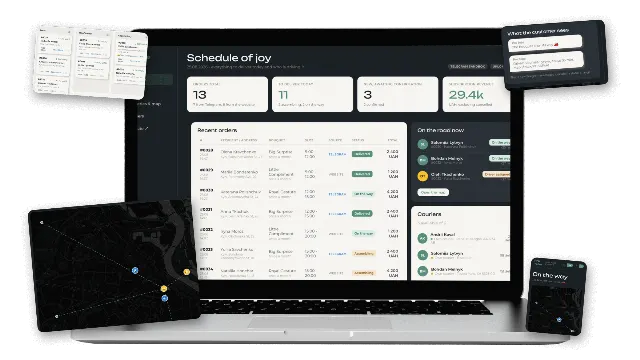
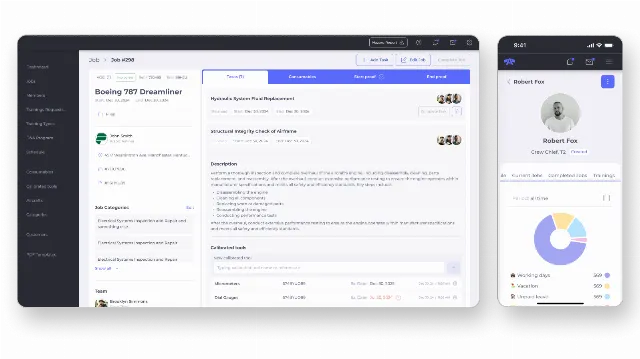
We are a software development company founded in 2020 that builds internal systems, SaaS products and AI features for companies in the US, UK and EU. Most of our work is the systems a voice agent has to talk to: CRMs, ERPs and order platforms, such as an order and courier dispatch system for a subscription retail business and an ERP for a US aircraft service company. Our in-house voice agent prototype speaks Ukrainian and offers callers a booked call.
If an AI receptionist app covers your calls, we will say so on the first call. If your calls need your own data and rules, see our AI agent development page; we start with your real call recordings, give a fixed quote after a short scoping call and hand over code you own.