 En
En
 Fr
Fr
 De
De
 It
It
 Es
Es
 Uk
Uk
Nearshore vs offshore: what is the difference?
The difference between nearshore and offshore software development is how far the team is from you, measured mostly in time zones. Nearshore means a team in a nearby country, usually within zero to three hours of your working day. Offshore means a team in a distant country, often six to twelve hours away, where the shared working day is short or absent. A third term, onshore, means a team in your own country.
The terms describe your position, not the vendor's. The same company can be nearshore for one client and offshore for another. That is why comparing "nearshore vs offshore" as fixed categories is misleading: the useful question is how many working hours you will share with the team, what it costs, and what legal and practical risks come with that specific country and vendor.
Why is Ukraine nearshore for Europe and offshore for the US?
Ukraine is nearshore for the UK and the EU because Kyiv is only one or two hours ahead of their capitals, and offshore for the US because it is seven to ten hours ahead of US cities. The country is the same; the time difference, and therefore the working model, changes with the client.
| Client location | Difference with Kyiv (usual) | What Ukraine is for this client | Shared working hours |
|---|---|---|---|
| London | 2 hours | Nearshore | Full working day |
| Paris, Berlin, Warsaw | 1 hour | Nearshore | Full working day |
| New York | 7 hours | Offshore | US East Coast mornings |
| San Francisco | 10 hours | Offshore | Very short; mostly async |
Kyiv is on UTC+2 in winter and UTC+3 in summer. For a few weeks each spring and autumn the gap with the US shifts by an hour, because the US and Europe change clocks on different dates. For a US East Coast company, a Ukrainian team therefore works like a good offshore team with a reliable morning overlap. For a London or Berlin company, it works like a nearshore team sitting one or two hours away. Our guide on outsourcing software development to Ukraine covers the Ukrainian market in more depth.
Which regions are nearshore and offshore for US, UK and EU companies?
Nearshore regions are the ones inside your working day: Latin America for US companies, Central and Eastern Europe for UK and Western European companies. Offshore regions are the distant ones: India and Southeast Asia for almost everyone, and Eastern Europe for the US.
| Buyer | Typical nearshore options | Typical offshore options |
|---|---|---|
| US company | Mexico, Colombia, Brazil, Argentina, Canada | Ukraine, Poland and wider Eastern Europe, India, Philippines, Vietnam |
| UK company | Poland, Ukraine, Romania, Portugal, the Baltics | India, Southeast Asia, Latin America |
| Western European company | Poland, Ukraine, Romania, the Baltics, Portugal | India, Southeast Asia, Latin America |
This is why "nearshore software development" searches from the US mostly lead to Latin American vendors, while the same search from the UK or Germany leads to Central and Eastern Europe.
How do nearshore and offshore compare on time zones, cost, communication, legal terms and risk?
Nearshore wins on live collaboration and usually on legal familiarity; offshore usually wins on rates and talent pool size. The table below summarizes the differences for a typical buyer, and the sections after it go through each factor.
| Factor | Nearshore | Offshore |
|---|---|---|
| Time difference | 0 to 3 hours | 6 to 12 hours |
| Shared working hours | Most or all of the day | 0 to 4 hours, often with a shifted schedule |
| Typical agency rates (market estimate) | Mid-range for the buyer's region | Lowest available |
| Communication style | Live calls whenever needed | Written specs, async updates, one planned daily call |
| Feedback loop | Same day | Often next day ("follow the sun") |
| Travel for workshops | Short flights, same or next day | Long-haul, rarely done |
| Legal framework | Often similar (for example EU to EU) | Different jurisdiction, contracts under foreign law common |
| Main risks | Higher cost, talent competition | Slower decisions, communication gaps, jurisdiction and country risk |
| Best for | Products needing daily collaboration and fast iteration | Well-scoped work, clear specs, budget-sensitive projects |
Time zones
Time zone overlap is the real dividing line between nearshore and offshore. With four or more shared hours, a team can join your planning, ask questions live and ship changes the same day. With one or two shared hours, work has to be planned so that nobody waits: questions batched into one daily call, decisions written down, and demos recorded. Offshore can turn the gap into an advantage when a US team reviews in the morning what was built overnight, but only if requirements are clear.
Cost
Offshore is usually cheaper per hour, but the total cost of a project depends on how much coordination, rework and management time it needs. The ranges below are typical agency rates we see in the market in 2026, clearly labeled as market estimates, not quotes from any vendor and not our rates:
| Region | Typical agency rate (2026 market estimate) | Nearshore for | Offshore for |
|---|---|---|---|
| United States | $100 to $200+ per hour | - | - |
| UK and Western Europe | $80 to $160 per hour | - | - |
| Poland and Central Europe | $45 to $90 per hour | UK, EU | US |
| Ukraine (senior engineers) | $30 to $50 per hour | UK, EU | US |
| Latin America | $35 to $80 per hour | US | UK, EU |
| India and Southeast Asia | $20 to $50 per hour | - | US, UK, EU |
Hourly rates compare poorly across vendors because output per hour varies so much. A better comparison is the price of the same written scope. As a Ukrainian agency, these are our typical ranges by project type, with a fixed quote after a short scoping call:
| Project type | Lytvynov Production (typical range) |
|---|---|
| Website or simple web app | $10,000 to $15,000 |
| MVP (web or mobile) | $10,000 to $50,000; most land at $10,000 to $20,000 |
| SaaS product | from $10,000 |
| AI feature, AI agent or AI chatbot | from $10,000 |
| Full online business (product, admin, payments, integrations) | $35,000 to $70,000 |
| ERP/CRM for a mid-size company | $40,000 to $90,000 |
| Complex AI product (fine-tuning, RAG memory, custom models) | $60,000 to $150,000 |
| Very large multi-platform product | $100,000 and up |
A US or UK agency typically quotes 2.5 to 4 times more for the same scope. Our minimum project size is $10,000. The hidden costs of distant teams, and how to budget for them, are covered in our guide on offshore software development cost.
Communication
Nearshore communication feels like working with a colleague in another office; offshore communication works best when it is written. With a nearshore team you can call about a question and get an answer in minutes. With an offshore team, good specifications, a tracker that everyone reads, short recorded videos and one daily live call replace most ad hoc conversations. Language level matters in both models: check it in the first call with the actual engineers, not only with sales.
Legal and contracts
Nearshore partners often share or resemble your legal framework, while offshore contracts more often cross jurisdictions. An EU company working with a vendor inside the EU stays within one data protection regime. Ukraine is not in the EU, so EU and UK clients that pass personal data to a Ukrainian team typically sign a data processing agreement and use standard contractual clauses. Whatever the location, the contract should assign intellectual property to you, name the governing law and forum, and define exit and handover terms.
Risk
Every outsourcing location carries some risk; the question is which kind and how the vendor manages it. Nearshore risks are mostly commercial: rising rates and competition for talent. Offshore risks are slower decisions, misunderstandings and jurisdiction distance. Country risk applies to both: Ukraine, for example, has operated under war conditions since 2022, and Ukrainian vendors that kept delivering did so with distributed teams, backups and cloud-hosted infrastructure. Ask any vendor, in any country, what happened to their delivery during their worst disruption.
When should you choose nearshore software development?
Choose nearshore software development when the product needs daily collaboration: an early-stage MVP with changing requirements, a team that must join your standups, or a project with many stakeholders who need quick answers. The higher hourly rate is often repaid in fewer misunderstandings and faster decisions.
Nearshore is also a good fit when your company prefers live workshops, when you plan occasional on-site visits, or when a shared legal framework (for example, both sides inside the EU) simplifies compliance. For UK and EU companies, Ukraine and Poland are the two most common Central and Eastern European options.
When is offshore software development the better choice?
Offshore software development is the better choice when the scope is well defined, the budget matters, and your team is comfortable with written, asynchronous collaboration. Mature products with a clear backlog, well-specified integrations and long-running maintenance work all fit offshore teams well.
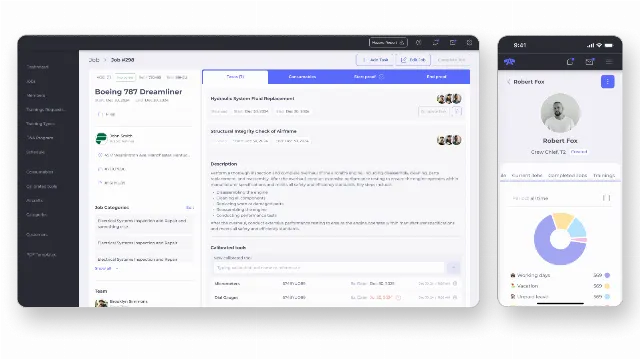
For US companies, Eastern Europe is a common middle option: offshore in time zone terms, but with a dependable morning overlap with the East Coast and senior engineering. Our work for a US aircraft service company, a custom ERP built over six months on Symfony/PHP, React, SQL and Mercure, is a typical example of this setup.
Examples: the same team, nearshore and offshore
Our own client list shows how one Ukrainian team can be nearshore for some clients and offshore for others:
- UK, nearshore. A sports events calendar for a UK-based sports tech company, with a custom engine that aggregates fixtures from hundreds of calendars and feeds, plus APIs and widgets for B2B clients. Two hours apart, the working days overlap almost fully.
- France, nearshore. A freelance experts platform: the rebuilt public web experience of a French IT consultant marketplace, delivered within a fixed scope with a design system the client team now reuses.
- US, offshore. The custom ERP for a US aircraft service company, run with written specifications and calls in the US morning.
More about how we work as a company is on our page about us as a software development company in Ukraine.
How do you choose between nearshore and offshore?
Choose by working hours first, then budget, then the vendor. Decide how many shared hours your team really needs; many teams need three or four, not eight. Then compare the price of the same written scope from two or three vendors, and pick the one whose engineers, process and contract you trust.
A short checklist:
- Overlap. How many hours per day will your product owner actually be available for live questions?
- Scope clarity. Clear written scope favors offshore; exploratory work favors nearshore.
- Total cost. Compare fixed quotes for the same scope, not hourly rates, and add your own management time.
- Legal fit. Data protection, governing law, IP assignment and exit terms.
- Continuity. How the vendor handles outages, departures and handovers.
- Engagement model. Fixed-scope milestones for a defined build, or a dedicated development team for an evolving product.
Next step
If you are in the UK or EU, we are a nearshore team; if you are in the US, we are an offshore team with a morning overlap on the East Coast. Either way, the start is the same: describe your project through the contact form or get a first range from the price estimate form, and after a short scoping call you receive a written scope and a fixed quote.