 De
De
 En
En
 Fr
Fr
 It
It
 Es
Es
 Uk
Uk
How much does offshore software development cost?
Offshore software development cost in 2026 typically ranges from about $20 to $90 per hour for agency engineers, depending on the region, compared with $100 to $200 or more per hour for agencies in the US. These are typical ranges we see in the market in 2026, not quotes from any vendor. In project terms, at Lytvynov Production most MVPs cost $10,000 to $20,000 and a website or simple web app $10,000 to $15,000, while a US or UK agency typically quotes 2.5 to 4 times more for the same scope. The real saving depends less on the rate and more on how well the work is scoped and managed.
Offshore software development means hiring a team in another country, usually a lower-cost one, to build or maintain your software. Some buyers use "nearshore" for countries in similar time zones (Latin America for the US, Central and Eastern Europe for Western Europe). The cost of offshore software development has two parts: the price on the vendor invoice, and the costs on your side that no invoice shows. This guide covers both, and ends with a comparison against hiring in-house.
What are offshore developer rates by region in 2026?
Region is the biggest factor in the hourly rate. Typical blended agency rates we see in the market in 2026:
| Region | Typical agency rate (2026 market range) | Time zone fit | Common strengths |
|---|---|---|---|
| United States (onshore) | $100 - $200+ per hour | Full overlap with US | No distance, highest cost |
| UK and Western Europe | $80 - $160 per hour | Full overlap with Europe | Mature market, high cost |
| Poland and Central Europe | $45 - $90 per hour | Good overlap with Europe, partial with US East Coast | EU jurisdiction, strong engineering |
| Ukraine | $30 - $50 per hour (senior engineers) | Good overlap with Europe, partial with US East Coast | Strong senior talent, mid-range rates |
| Latin America | $35 - $80 per hour | Strong overlap with US | Time zone fit for US teams |
| India | $20 - $50 per hour | Limited overlap with US and Europe | Large talent pool, lowest rates |
| Southeast Asia (Vietnam, Philippines) | $20 - $50 per hour | Limited overlap with US and Europe | Growing market, low rates |
Rates inside each region vary with seniority, technology and the vendor's overhead. Senior engineers in AI, security or complex domains sit at the top of a range or above it. For a closer look at one of these markets, including war-time continuity, read our guide to outsourcing software development to Ukraine.
What does an offshore project cost in total?
A typical offshore project costs the vendor's quote for the scope, plus 10 to 30 percent for your own management, communication and rework. The blended rate matters more than the headline rate, because a team mixes senior, mid-level, QA, design and project management time, so it is more useful to compare prices per scope than per hour.
These are our typical ranges at Lytvynov Production, with a typical US or UK agency quote for the same scope as a comparison (roughly 2.5 to 4 times ours):
| Project scope | Lytvynov Production (typical range) | Typical US/UK agency |
|---|---|---|
| Website or simple web app | $10,000 - $15,000 | $25,000 - $60,000 |
| MVP (web or mobile), most projects | $10,000 - $20,000 (up to $50,000) | $30,000 - $80,000 |
| SaaS product | from $10,000 | from $30,000 |
| AI feature, AI agent or AI chatbot | from $10,000 | from $25,000 |
| Full online business (product, admin, payments, integrations) | $35,000 - $70,000 | $125,000 - $200,000 |
| ERP/CRM for a mid-size company | $40,000 - $90,000 | $160,000 - $260,000 |
| Very large multi-platform product | $100,000 and up | $300,000 - $1,000,000 |
We give a fixed quote after a short scoping call, so the number on the contract is the number for the agreed scope. On top of any offshore quote, plan 10 to 20 percent of your own time for product decisions, reviews and acceptance.
The illustration also shows the main risk. If an offshore team at a lower rate needs twice the hours because of weak seniority or unclear scope, most of the saving disappears. Our MVP development cost guide shows how scope drives hours for new products.
What are the hidden costs of offshore software development?
The hidden costs of offshore development are the costs that appear on your side rather than on the vendor invoice. They typically add 10 to 30 percent to the invoiced amount, and more with a weak vendor.
| Hidden cost | Why it appears | How to reduce it |
|---|---|---|
| Your management time | Someone has to prioritize, answer questions and accept work | A vendor-side project manager, written backlog, weekly demos |
| Time zone delays | Questions wait until the next working day | At least 3-4 hours of daily overlap, async written updates |
| Onboarding and knowledge transfer | New people need to learn the product and domain | Documentation, recorded walkthroughs, stable team |
| Rework | Requirements were misread or not written down | Acceptance criteria per task, early prototypes |
| Vendor turnover | Engineers leave or rotate between clients | Contract terms on replacement and handover |
| Quality gaps | No dedicated QA, no automated tests | QA role in the team, CI with tests from the first sprint |
| Legal and payment overhead | Contracts, currency conversion, transfer fees | Standard contract, clear invoicing terms |
| Security and access | Accounts, VPNs, audits, data handling | Client-owned repositories and cloud accounts |
Most of these costs come from weak scoping and communication, not from the offshore location itself. A team one hour away can generate the same rework if nobody writes down what "done" means.
Is offshore development cheaper than hiring in-house?
Offshore development is usually cheaper than hiring in-house in the US or UK, often by 40 to 60 percent on total cost for the same output, but the comparison has to include everything an employee costs, not only salary. In-house hiring also brings benefits that offshore work does not, such as long-term product knowledge held inside the company.
A fair comparison of total cost of ownership looks at these lines:
| Cost line | In-house team (US or UK) | Offshore agency team |
|---|---|---|
| Salary or rate | Full salary, paid whether or not there is work | Hourly or monthly rate, scaled to the work |
| Employer taxes and benefits | Commonly 20 to 40 percent on top of salary | Included in the rate |
| Recruiting | Recruiter fees or internal time, weeks to months per hire | Vendor staffs the team, usually within weeks |
| Equipment, software, office | Paid by you | Included in the rate |
| Management | Your engineering managers | Shared: vendor PM plus your product owner |
| Ramp-up | Weeks per new hire | Weeks per new team, repeated if people change |
| Scaling down | Notice periods, severance | Contract notice period |
| Knowledge retention | Stays in the company | Depends on documentation and team stability |
In-house makes sense for the core of a product you will develop for many years, especially once you have a technical leader to hire and manage the team. Offshore makes sense for building a first version, adding capacity quickly, covering a stack you do not have in-house, or running a long-term product with a stable external team. Many companies combine both: an in-house product owner or CTO with an offshore dedicated team.
Which engagement model affects offshore cost the most?
The engagement model changes who carries the risk of overruns, and therefore the price. A fixed price moves scope risk to the vendor, who adds a buffer; time and materials keeps the risk with you at the plain rate; a dedicated team gives you a stable monthly cost for a set of people.
For a new product with a clear scope, fixed-scope milestones cap your exposure. For a product that changes every sprint, a dedicated development team at a monthly rate is usually cheaper than a series of fixed-price change requests. We compare the three models, including contract terms, in our guide to dedicated team vs fixed price.
What do real offshore projects look like?
Real offshore projects that stay on budget share the same features: a written scope, regular demos and a team that stays stable from start to finish. Three examples from our own work with clients in the US, UK and France:
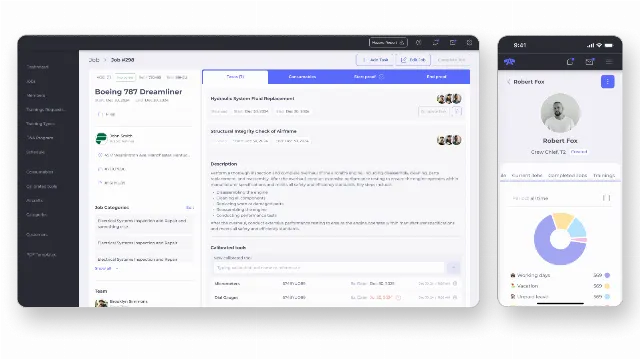
- US aircraft service company. We built a custom ERP system over six months with Symfony/PHP, React, SQL and Mercure: client and order management, service scheduling, staff shifts with calendar integrations, real-time warehouse inventory and regulatory compliance monitoring. The system became part of the client's daily operations.
- French IT freelance marketplace. We rebuilt the public web experience after a rebrand: design system, landing pages, freelancer search, public profiles and authentication flows. The freelance marketplace project was delivered within a fixed scope and budget, and the client's team now uses the Figma design system for new pages.
- UK sports tech company. We built a sports event calendar platform with a custom parsing engine that aggregates and normalizes data from hundreds of calendars and feeds, plus APIs and embeddable widgets for B2B clients.
How do you compare offshore quotes fairly?
Compare offshore quotes against the same written scope and check what each includes, rather than comparing hourly rates. A lower rate with no QA, no project manager and no deployment work can cost more in total.
Questions that make offshore quotes comparable:
- What is the blended rate across all roles, not only developers?
- Are design, QA, project management and DevOps included?
- Who exactly will work on the project, and at what seniority?
- How many hours of overlap with your working day are guaranteed?
- What happens if an engineer leaves, and who pays for the handover?
- Who owns the code, repositories, cloud accounts and API keys from day one?
- How are change requests estimated and approved?
Our checklist for choosing a development partner covers more questions and red flags.
How we work with offshore clients at Lytvynov Production
Lytvynov Production is a web, mobile and AI development agency from Ukraine working remotely with startups and B2B companies in the US and Europe, in English, French and Ukrainian. Our main stack is PHP/Symfony on the back end, React, Vue or Angular on the front end, React Native or Flutter for mobile, and OpenAI or Claude APIs for AI features. Senior engineers lead delivery, and we use AI coding agents internally to speed up routine work.
We give a fixed quote after a short scoping call, then work in fixed-scope milestones or as a dedicated team, and we recommend keeping repositories and cloud accounts in the client's name from day one. If you want a realistic estimate for your project, contact us with a short description and your target timeline.