 De
De
 En
En
 Fr
Fr
 It
It
 Es
Es
 Uk
Uk
Which is better: dedicated team, fixed price or time and materials?
No engagement model is better in general; each fits a different kind of project. Fixed price fits a clear, stable scope. Time and materials fits exploratory work with an engaged product owner. A dedicated team fits a product with an ongoing roadmap. The wrong model for the project, not the model itself, is what causes most budget disputes.
An engagement model is the commercial agreement that defines how a software vendor is paid and who carries the risk when the work takes longer than planned. Choosing between a dedicated team vs fixed price vs time and materials (T&M) is really a decision about three things: how well the scope is known today, how much it will change, and how much time you can spend managing the work. This guide walks through each model, then the contract terms that matter under all three.
How do the three engagement models compare?
The three models differ mainly in who carries the risk of overruns and how easily the scope can change. The table summarizes the trade-offs.
| Factor | Fixed price | Time and materials | Dedicated team |
|---|---|---|---|
| How you pay | Agreed price per project or milestone | Hours actually worked at agreed rates | Monthly fee per team member |
| Scope | Defined upfront, changes via change requests | Flexible, re-prioritized as you go | Flexible, you set the backlog |
| Budget certainty | High for the agreed scope | Low to medium, estimate only | High per month, total depends on duration |
| Who carries overrun risk | Vendor (priced in as a buffer) | Client | Client (but capacity is capped) |
| Your management effort | Low during build, high at acceptance | High, continuous prioritization | Medium to high, product owner needed |
| Speed to start | Slower, needs a detailed scope | Fast | Medium, team assembly takes weeks |
| Best for | MVPs and projects with a written scope | Discovery, R&D, unclear or changing work | Long-term products, ongoing roadmaps |
| Typical failure | Disputes over what was "in scope" | Hours grow without visible progress | Team idles or drifts without clear priorities |
When does a fixed price contract work best?
A fixed price contract works best when the scope is written down in detail, the acceptance criteria are clear and the project has a defined end. It gives the buyer a known cost and moves the risk of the vendor's own estimation errors to the vendor.
Good candidates for fixed price are an MVP after a scoping phase, a redesign of an existing product to an agreed design system, a specific integration, or a migration with a known start and end state. Our freelance marketplace project is an example: a French IT marketplace needed its public web experience rebuilt after a rebrand, including landing pages, freelancer search, public profiles and authentication flows, with desktop and mobile versions of every screen. The scope was clear from the brand guidelines, and the project was delivered within a fixed scope and budget.
The limits of fixed price are also clear. The vendor adds a buffer for uncertainty, so the price is often higher than the same work under T&M would have cost. Every change becomes a change request with its own estimate and approval. And a fixed price quote given before any scoping is either padded or likely to lead to disputes later. That is why the MVP development process we recommend puts a short scoping call and a written scope before any fixed quote.
When does time and materials make sense?
Time and materials makes sense when the work cannot be specified in advance and you can stay close to it. You pay for the hours actually worked at agreed rates, and you can change direction at any point without renegotiating a contract.
Typical T&M work includes discovery and prototyping, R&D where the approach is unknown, AI features whose accuracy must be tested before committing to a design, bug fixing and support on an existing system, and small continuous improvements. T&M is also a practical way to start with a new vendor: a few weeks of paid work shows how the team estimates, communicates and delivers before a larger commitment.
The risk of T&M is that hours grow while visible progress does not. The protection is process rather than contract: a prioritized backlog, estimates per task, weekly demos, a monthly budget cap that triggers a review, and time reports broken down by task. A T&M vendor who cannot tell you what each week of hours produced is the problem, not the model.
When should you hire a dedicated development team?
Hire a dedicated development team when your product has a roadmap measured in months or years and the work keeps changing with user feedback. A dedicated team is a stable group of people working only on your product for a monthly fee, so knowledge stays in the team instead of being rebuilt for every project.
A dedicated team fits a SaaS product after launch, a platform that adds features every sprint, a company that needs engineering capacity without hiring in-house, or a product where the team must learn a complex domain. Our work on Ritoria, a serialized-fiction platform with an in-app currency, three payment providers, a cover-design marketplace, forums and a back office in English and Arabic, shows what long-term product work looks like: the platform ran in production for two and a half years with 292 commits and 120 database migrations of continuous evolution. That kind of steady change is hard to price as a series of fixed-price projects.
A dedicated team needs a product owner on your side who sets priorities and accepts work. Without that role, even a strong team drifts. Our dedicated development team service explains roles, onboarding, reporting and how people are replaced.
How much does each engagement model cost?
The engagement model changes how the price is structured more than the underlying cost of the work. The same scope built by the same team costs roughly the same number of hours; what changes is the buffer, the overhead and who pays for surprises.
| Model | How the price is built | Typical cost effect |
|---|---|---|
| Fixed price | Vendor estimate plus a risk buffer | Buffer often 15 to 30 percent, plus change requests |
| Time and materials | Hours worked multiplied by the rate card | No buffer, total depends on scope control |
| Dedicated team | People multiplied by monthly rate | About 160 hours per person-month, predictable burn |
For fixed-scope work, it helps to see typical project prices rather than rates. With us, a website or simple web app typically costs $10,000 to $15,000, most MVPs $10,000 to $20,000 (up to $50,000), a SaaS product from $10,000, an AI feature, agent or chatbot from $10,000, a full online business $35,000 to $70,000 and an ERP/CRM for a mid-size company $40,000 to $90,000. A typical US or UK agency quotes roughly 2.5 to 4 times more for the same scope.
For a dedicated team, as an illustration using typical 2026 market rates of roughly $30 to $50 per hour for senior engineers in Ukraine, one full-time dedicated engineer costs about $4,800 to $8,000 a month, and a team of four (for example three developers and a QA engineer, with part-time project management) costs roughly $19,000 to $32,000 a month. The same team in the US or UK typically costs 2.5 to 4 times more. For rates by region and the hidden costs of remote teams, see our offshore software development cost guide.
Can you combine engagement models?
Yes, and most well-run projects do. A common sequence is a short scoping call that produces a written scope and a fixed quote, then fixed-scope milestones for the first release, then a dedicated team for the ongoing product.
| Phase | Typical model | Why |
|---|---|---|
| Scoping (short call, then written scope) | Fixed quote after the scoping call | Scope is still loose, output is a backlog and plan |
| First release or MVP | Fixed price per milestone | Scope is now written, cost can be capped |
| After launch | Dedicated team or T&M | Work follows user feedback, scope changes weekly |
| Maintenance | Monthly retainer or T&M | Small, unpredictable volume of work |
Fixed-scope milestones are a useful middle ground. Instead of one fixed price for the whole project, each milestone has its own scope, price and acceptance, so you can adjust priorities between milestones without renegotiating everything. Our MVP development cost guide shows typical budgets for the first release.
What contract terms matter under every engagement model?
The contract terms that protect you most are the same under fixed price, time and materials and a dedicated team: ownership, acceptance, change control, people and exit. Check each before signing.
- IP assignment. All code, designs and documentation are assigned to you, usually upon payment. The vendor must hold rights from its own engineers to pass them on.
- Client-owned accounts. Repositories, cloud accounts, domains and third-party API keys in your name from day one.
- Acceptance criteria. For fixed price, written criteria per milestone and a fixed acceptance window. For T&M and dedicated teams, a definition of done per task.
- Change control. How new requests are estimated, approved and priced, and who can approve them.
- People and replacement. Named roles and seniority, how quickly a leaving team member is replaced, and who pays for the handover.
- Reporting. Time reports by task, demo frequency and access to the task board.
- Warranty. For fixed price, a period after acceptance in which defects are fixed at no cost.
- Notice and exit. Notice period to scale down or stop, and the vendor's obligation to hand over code, documentation and access.
- Governing law and disputes. Which country's law applies and where disputes are resolved.
Which model fits your project? A quick checklist
Use the answers to these questions to choose an engagement model. If most answers point one way, that is usually the right starting model.
- Do you have a written feature list with acceptance criteria? Yes points to fixed price.
- Will the scope change based on what users do after launch? Yes points to a dedicated team.
- Is the technical approach still unknown, for example an AI feature whose accuracy is untested? Yes points to T&M.
- Do you have a product owner who can spend several hours a week on priorities? No points to fixed price with milestones.
- Is the work longer than six months? Yes points to a dedicated team.
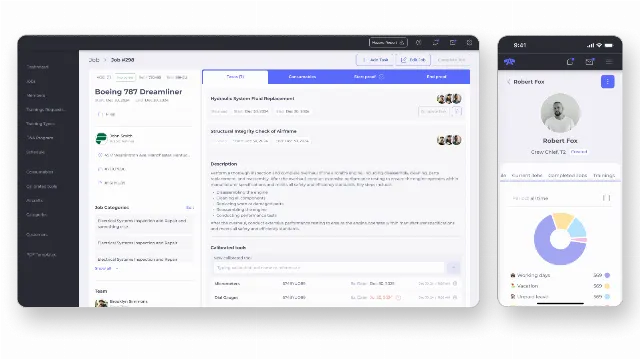
A six-month build like our custom ERP for a US aircraft service company, covering orders, service scheduling, staff shifts, warehouse inventory and compliance, is the kind of project where the choice is not obvious and the answer depends on how settled the requirements are at the start.
How we structure engagements at Lytvynov Production
Lytvynov Production gives a fixed quote after a short scoping call, then works in fixed-scope milestones or as a dedicated team, depending on how stable the scope is. Senior engineers lead delivery, and we use AI coding agents internally to speed up routine work. We work remotely with startups and B2B companies in the US and Europe.
If you are unsure which model fits your project, contact us with a short description, and we will tell you which model we would choose and why.