 Uk
Uk
 En
En
 Fr
Fr
 De
De
 It
It
 Es
Es
How much does it cost to build an AI app?
With Lytvynov Production, AI app development cost in 2026 typically ranges from $10,000 for adding one AI feature to an existing product to about $50,000 for a new AI-native app on web and mobile, and $60,000 to $150,000 for a complex AI product with fine-tuning and RAG memory. A typical US or UK agency quotes roughly 2.5 to 4 times more for the same scope. The final figure depends on scope, platforms, where the data comes from and how much the AI output has to be trusted, and we give a fixed quote after a short scoping call.
An AI app, in this guide, is a web or mobile application whose value depends on a large language model or another machine learning model: it writes, summarizes, answers questions, classifies documents or recommends actions. Most of the budget still goes into the ordinary app around the model (accounts, payments, screens, admin, hosting). The AI layer adds its own work: prompt design, output validation, evaluation, usage limits and a monthly model bill that a normal app does not have.
What does an AI app cost by scope?
Scope is the largest cost driver for an AI app, and the second largest is how deep the AI goes: calling a hosted model, retrieving your own data, or training a custom model. The table shows our typical ranges (design, development, QA and deployment included) next to what a typical US or UK agency quotes for the same scope.
| AI app type | Typical scope | Typical timeline | With Lytvynov Production | Typical US/UK agency |
|---|---|---|---|---|
| AI feature in an existing app | One or two features on OpenAI or Claude API, prompt templates, limits | 3-8 weeks | from $10,000 (typically $10,000 - $15,000) | $25,000 - $60,000 |
| AI app over company data | RAG over documents or databases, permissions, evaluation set | 10-18 weeks | $10,000 - $40,000 | $25,000 - $160,000 |
| AI-native web MVP | New web app, accounts, billing, core AI workflow, admin | 8-14 weeks | $12,000 - $50,000 | $30,000 - $200,000 |
| AI app on web plus mobile | Web app plus iOS and Android (React Native or Flutter) | 12-20 weeks | $20,000 - $50,000 | $50,000 - $200,000 |
| AI app with custom models | Fine-tuning or LoRA training, RAG memory, GPU inference, data pipelines | 4-9 months | $60,000 - $150,000 | $250,000 - $400,000+ |
Products built around fine-tuning and RAG memory sit in the last row and cost $60,000 to $150,000 with us. For the non-AI part of the budget (roles, platforms, integrations) our MVP development cost guide goes deeper, and for apps whose main job is to take actions in other systems, see the AI agent development cost guide.
Where does the money go inside an AI app budget?
In most AI app projects, 60 to 80 percent of the budget goes into the ordinary product and 20 to 40 percent into the AI layer. The model call is a few lines of code; the cost sits in everything that makes the output usable and safe.
A typical AI app budget splits into these parts:
- Product and UX design. AI apps need extra states: loading while the model thinks, streaming text, retry, edit and "this answer is wrong" feedback.
- Core application. Accounts, subscriptions, payments, data storage, admin panel and notifications, the same as any SaaS product.
- AI layer. Prompt templates stored outside the code, structured output parsing, validation, fallbacks when the model fails or times out.
- Data layer. Document ingestion, chunking and a vector store such as pgvector or Qdrant if the app answers from your own content.
- Evaluation. A set of real examples scored automatically, so every prompt or model change can be checked before release.
- Cost controls. Per-user quotas, rate limits, caching and model routing, built in from the first release.
- Release and operations. CI/CD, monitoring, error tracking, logs of AI requests, and app store work for mobile.
Cheap quotes usually cut evaluation and cost controls first, because neither is visible in a demo. Both are expensive to add later, after users and invoices have already arrived.
Why is an AI mobile app more expensive than a web app?
An AI mobile app typically costs 30 to 60 percent more than the same AI app on the web only, because two more platforms need design, testing and store releases. Cross-platform frameworks like React Native and Flutter keep one codebase for iOS and Android, which limits the extra cost but does not remove it.
Mobile adds specific AI work as well. Streaming model responses over unstable mobile networks needs careful handling, uploads of photos or documents need compression and background processing, and API keys must never live in the app itself, so every model call goes through your own back end. App store review also applies to AI features: stores expect content moderation and clear reporting options for generated content.
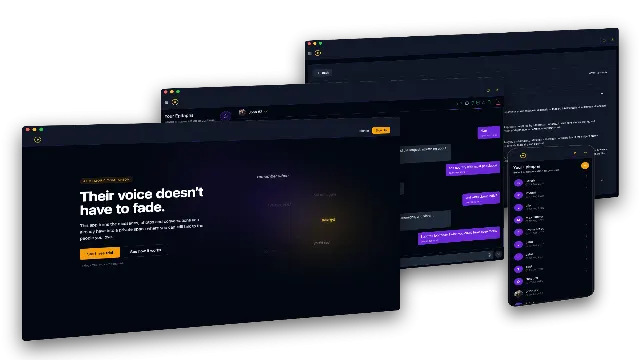
Our AI Grief Companion project shipped a React web client plus iOS and Android apps in React Native on top of one shared API. A common path for a first release is simpler: a responsive web app that works well on phones, and native apps once real usage justifies them.
How much does the AI model choice change the cost?
The model strategy can move an AI app budget by a factor of two or more. Hosted APIs are the cheapest to build on; custom training and self-hosted models are the most expensive to build and to run.
| Model strategy | Build cost impact | Monthly run cost | When it fits |
|---|---|---|---|
| Hosted API (OpenAI, Anthropic Claude) | Lowest | Pay per token, scales with usage | Most AI apps, especially first versions |
| Hosted API plus RAG | From $10,000 with us (2.5 to 4 times that at a US/UK agency) | Tokens plus vector store | Answers must come from your own data |
| Open model, self-hosted | Adds infrastructure and MLOps work | GPU servers, fixed monthly cost | Strict data rules or very high volume |
| Fine-tuned or LoRA model | Adds $20,000 and up with us; a full product built around it is $60,000 to $150,000 | GPU inference plus training runs | Specific voice, format or behavior |
In the AI Grief Companion project the product required a model that answers in the voice of one specific person, so the platform trains LoRA adapters on an open model (Qwen2.5-7B) and serves them with vLLM, alongside a RAG memory layer. That is a justified exception. For most business and consumer AI apps, a hosted model with good prompts and retrieval gets to market faster and costs less. Our generative AI development service covers how we make this choice.
What does an AI app cost to run each month?
A small AI app typically costs from a few hundred to a few thousand dollars a month to run, and the model bill grows with every active user. Unlike a normal app, where hosting costs rise slowly, an AI app pays for each request it sends to a model.
| Monthly cost line | What it covers | Typical range (market, 2026) |
|---|---|---|
| Model usage (tokens) | Every AI request, input and output | $50 - $5,000+ |
| Hosting and database | API, workers, queues, storage | $50 - $800 |
| Vector database | Retrieval store, if the app uses RAG | $0 - $500 |
| GPU inference | Only for self-hosted or fine-tuned models | Several hundred to several thousand dollars |
| Monitoring and logs | Errors, traces, AI request logs | $0 - $300 |
| App stores | Apple developer program, Google Play registration | About $99 per year plus a one-time $25 |
| Maintenance | Prompt and model updates, fixes, dependency upgrades | Often 15 to 25 percent of build cost per year |
Here is an illustrative calculation with assumed numbers, not a quote. An app has 5,000 monthly active users, each making 30 AI requests a month. Each request uses about 3,000 tokens, so the app consumes 450 million tokens a month. At an assumed blended price of $2 per million tokens, the model bill is about $900 a month, or under 20 cents per active user. A frontier model for every request can multiply that; routing simple tasks to a small model can cut it sharply.
What drives AI app development cost up or down?
AI app cost goes up with every source of uncertainty in the output and every system the app must touch. It goes down when the first release focuses on one AI workflow that users actually pay for.
Drivers that raise the estimate:
- Trust requirements. Health, legal, finance and grief-related apps need stricter prompts, moderation, human escalation and more evaluation cases.
- Your own data. Ingesting PDFs, spreadsheets, chat exports or databases means parsers, cleaning and access rules. The AI Grief Companion ingestion layer reads ten chat-export formats before any AI runs.
- Privacy. Encryption at ingest, deletion on request and data residency add design and testing time.
- Multiple modalities. Voice, image or document understanding each add models, storage and edge cases.
- Real-time features. Streaming answers, live collaboration and notifications need extra infrastructure.
Drivers that lower it:
- One core AI workflow in the first release, with others added after launch.
- Hosted models first, with the option to switch providers because prompts and model calls sit behind one interface.
- Managed services for authentication, payments, email and storage.
- A generated admin panel instead of a custom back office.
How long does it take to build an AI app?
A focused AI app typically takes 8 to 14 weeks from scoping to launch, and an AI app on web plus mobile takes 12 to 20 weeks. Apps with custom model training take four months or more because data preparation and training runs add their own timeline.
Our own product AI Resume Master is an example of the focused path. It was built in about three months as a web platform with desktop and mobile-optimized versions. An LLM generates, rewrites and improves resume content and writes tailored cover letters, next to standard features like templates, LinkedIn import and PDF export. The product reached 50,000 monthly active users. The AI features were the core value, but most of the build was the product around them.
How can you reduce the cost of an AI app?
The safest way to reduce AI app cost is to cut scope and model complexity before development starts. Cutting evaluation or cost controls during development saves little and usually costs more after launch.
Practical ways to keep the budget down:
- Validate with a narrow AI workflow. One feature users would pay for beats five features in beta.
- Start with a hosted model. Add retrieval when answers must come from your data, and consider fine-tuning only after real usage shows a gap.
- Design for model changes. Store prompts in the database with version history so tone and instructions change without a release.
- Launch on the web first. A responsive web app reaches mobile users without app store work.
- Set limits from day one. Per-user quotas protect both the budget and the product from abuse.
How we price AI app development at Lytvynov Production
Lytvynov Production builds AI apps with PHP/Symfony or Node on the back end, React or Vue on the web, React Native or Flutter on mobile, and OpenAI or Claude APIs, RAG and, when the product needs it, LoRA fine-tuning. Senior engineers lead every project, and we use AI coding agents internally to speed up routine work.
AI features start from $10,000 with us, and most AI-native MVPs land at $12,000 to $50,000. Because two AI apps with the same description rarely share the same scope or data, we give a fixed quote after a short scoping call: we agree the scope, estimate the monthly model bill on your expected volumes, and split the build into milestones. If you want to take an AI product from idea to production, see our AI product development service or tell us about your app.