 Uk
Uk
 En
En
 Fr
Fr
 De
De
 It
It
 Es
Es
Python vs Node.js for an AI back end: which should you choose?
Python vs Node.js for an AI back end depends on whether your product uses models or builds them. If the back end calls hosted models such as OpenAI or Anthropic Claude, streams answers to users and runs agent tools against your own data, Node.js in TypeScript is usually enough and keeps one language with your React front end. If the back end processes large document sets, fine-tunes models, or runs open models on your own GPUs, Python is the better tool, because that is where the AI and data ecosystem lives.
Most AI products we build use both. Our Python development work covers FastAPI services, ingestion pipelines, RAG and fine-tuning. Our Node.js development work covers product APIs, real-time features and AI streaming. This guide explains how we split the work and when one language is enough.
In short:
- Node.js alone for products that call hosted models, stream answers and run agent tools.
- Python alone for internal AI services, data products and model work without a large user-facing product around them.
- Both when the product needs accounts, billing and real-time screens and also heavy AI or data processing.
How do Python and Node.js compare for AI work?
| Criterion | Python (FastAPI) | Node.js (TypeScript) |
|---|---|---|
| OpenAI and Claude SDKs | Official, first-class | Official, first-class |
| Streaming answers to users | Good with async frameworks | Natural fit with the event loop |
| Agent tool calls and MCP servers | Official SDKs and frameworks | Official SDKs and frameworks |
| RAG basics (chunking, embeddings, retrieval) | Very strong tooling | Good for typical cases |
| Heavy ingestion: OCR, tables, many formats | Best ecosystem | Limited; often calls out to other tools |
| Fine-tuning and training | The standard (PyTorch and related libraries) | Not practical |
| Hosting open models on GPUs | The standard (for example vLLM) | Calls a Python or hosted inference service |
| Evaluation and data analysis | Very strong | Possible, fewer tools |
| Sharing types with React and React Native | Through generated API clients | Directly, same language |
| Real-time product features | Possible | Very strong |
| Hiring pool | Large, strong in data and ML | Very large, strong in product engineering |
When is Node.js enough for an AI product?
Node.js is enough when the intelligence comes from a hosted model and the back end's job is product engineering around it: authentication, per-user limits, prompts, streaming, tool calls, logging and fallbacks. That covers a large share of AI features: chat assistants, drafting and rewriting, summaries, classification, extraction from short documents, and agents that act through your own APIs.
On Node.js the server calls the model in streaming mode and forwards each chunk to the browser over server-sent events or a websocket. Around that we add cancellation when the user leaves, cost controls, and clear messages in the interface when a provider is slow. Because the React or React Native client is also TypeScript, message and tool schemas are shared, and a changed contract breaks the build instead of production.
Your existing back end may also be enough. If it is PHP, the same features can be built there; see our guide to integrating ChatGPT or Claude into your product.
When do you need Python?
You need Python when the AI work moves from calling models to processing data at scale or changing the model itself. The signals we look for:
- Many source formats: chat exports, PDFs with tables, scanned documents, spreadsheets and email archives that must be parsed and normalized.
- Heavy RAG: large or fast-changing corpora, hybrid or graph retrieval, rerankers and evaluation sets that measure retrieval quality.
- Fine-tuning: LoRA adapters or other training on your own data when prompts and retrieval cannot hold a required voice or format.
- Self-hosted open models on your own GPUs for cost, privacy or latency reasons.
- Data science: analysis, scoring or forecasting that relies on libraries that exist only in Python.
In these cases, trying to stay in Node.js means calling out to Python tools anyway, or reimplementing them badly. A focused Python service is cheaper and safer.
How do you combine Python and Node.js in one AI product?
The pattern we use: the product back end owns accounts, billing, permissions and real-time delivery; a Python service owns AI and data work and exposes a small typed API. Short tasks return directly; long tasks become background jobs that report back by callback or a status endpoint.
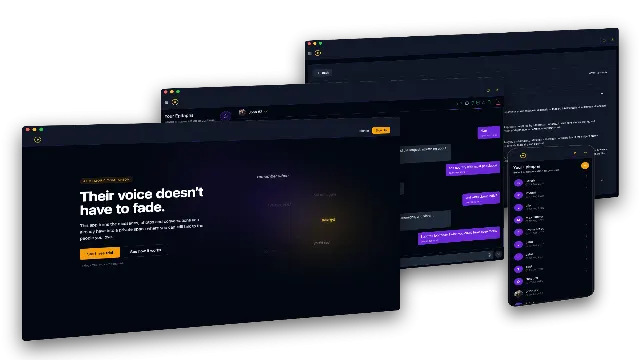
The AI Grief Companion we built for a US startup follows this split:
- Node.js 22 and Express on PostgreSQL for the product: accounts, subscriptions through Stripe and Apple in-app purchases, message storage, and a websocket that carries each reply to the React web client and the React Native apps.
- Python, FastAPI and Celery with PostgreSQL, Redis and Neo4j for the AI platform: a gateway that parses ten chat-export formats into one normalized message table, LoRA training of a persona model on Qwen2.5-7B, vLLM serving the right adapter per request, and memory from three retrieval layers over a fact graph.
The chat works with the base model minutes after upload and improves as each training stage finishes, so the interface never waits for the slowest part of the pipeline. Each part of the system uses the language that suits it.
The same split works with PHP instead of Node.js. Our own product AI Resume Master runs PHP and Symfony for the product, React for the interface and Python for AI resume and cover letter generation, and reached 50,000 monthly active users.
How do RAG and agents differ between the two?
For RAG, both languages can chunk documents, create embeddings through an API, store vectors and retrieve with permission checks. Node.js handles that for a knowledge base of normal size and structure. Python pulls ahead on ingestion quality: parsing difficult formats, cleaning and deduplicating, chunking that follows document structure, and evaluation sets that tell you whether retrieval actually improved. Good RAG starts with good ingestion; our RAG implementation guide explains why.
For agents, both ecosystems have official SDKs for tool calling and for the Model Context Protocol, so the language matters less than the design: tools that act through your existing business logic, permission checks on every call, and human approval for anything involving money or customer communication. We usually run agent tools in the main product back end, because that is where permissions live.
How do hosting and costs compare?
The language barely changes the build cost; scope and data do. With us, an AI feature built on hosted models typically starts at $10,000, an AI app over company data with RAG costs $10,000 to $40,000, and a product with custom models, such as LoRA fine-tuning, RAG memory and GPU inference, lands at $60,000 to $150,000.
| Running cost | Node.js only | Node.js or PHP plus Python |
|---|---|---|
| Model usage | Per token from the provider | Per token, or GPU time for self-hosted models |
| Services to run | One back end | Two services plus a job queue |
| GPU infrastructure | None | Only if you host or fine-tune open models |
| Operational complexity | Lower | Higher, but each service scales and deploys on its own |
A second service adds deployment and monitoring work, so we add Python only when one of the signals above is present. For the full picture of build and run costs, see AI app development cost.
Which is easier to hire for and maintain?
Node.js draws on the JavaScript and TypeScript pool, the largest in software, and a React developer can contribute to a TypeScript AI back end quickly. Python draws on a large pool that is strongest in data and machine learning; engineers who combine solid product engineering with ML experience are rarer and more expensive. If your future in-house team is mostly product engineers, keeping the main back end in Node.js or PHP and the Python service small makes hiring easier.
Maintenance differs in where change comes from. On the Node.js side it is mostly SDK and package updates as model providers add features. On the Python side it is also model and library versions, GPU drivers and retraining when your data changes. In both, the most valuable maintenance asset is an evaluation set checked in CI, so a new model, prompt or library version is measured before it reaches users.
When should you pick Python, Node.js or both?
| Your situation | Our recommendation |
|---|---|
| Chat assistant or copilot on hosted models, TypeScript team | Node.js |
| AI features inside an existing PHP or Node.js product | Existing back end; no new language |
| RAG over a modest, well-structured knowledge base | Existing back end or Node.js |
| RAG over large, messy, many-format document sets | Python service for ingestion and retrieval |
| Fine-tuning, LoRA or self-hosted open models | Python with GPU workers |
| Internal data or scoring service with no user-facing app | Python with FastAPI |
| Consumer AI app with web, mobile and custom models | Node.js or PHP product back end plus a Python AI service |
Our verdict: start with the back end you have or the one that fits your product team, and call hosted models from it. Add a Python service when data processing or model work demands it, not before. If you are also choosing between Node.js and PHP for the product itself, see Node.js vs PHP for a SaaS back end.
How we design AI back ends with clients
We start with a short call about the product, the data and what the AI should do. The first milestone usually includes an evaluation set, so quality is measured from week one, and a fixed quote. Delivery runs in milestones with weekly demos, in your repositories and cloud accounts. See our Python development, Node.js development, RAG development and AI integration services, or contact us to discuss your AI product.