 Es
Es
 En
En
 Fr
Fr
 De
De
 It
It
 Uk
Uk
What is AI product development?
AI product development is the work of taking a product whose core value comes from AI from an idea to a product people use and pay for. It covers product discovery, data, model choice, evaluation, the surrounding application, launch and the operating work after launch. The difference from ordinary product development is that the most important part of the product, the quality of the model's output, is not fully under your control and changes when the model, the data or the users change.
That is why AI product development services need both product thinking and engineering discipline. A persuasive demo can be built in a few days. A product that stays accurate for thousands of users, at a cost per user that leaves a margin, takes a process. If you only need one AI feature inside an existing app, AI integration is the shorter path; this page is about products where the AI is the reason the product exists.
What are the stages of the AI product development process?
The AI product development process has six stages, and each one should end with evidence that justifies the next. This is the lifecycle we follow with clients and on our own products:
| Stage | Typical length | Question the stage must answer | Output |
|---|---|---|---|
| 1. Discovery | 1 to 2 weeks | Who has the problem, and what would a good output look like to them? | User roles, core job to be done, quality definition, scope |
| 2. Data readiness | 1 to 3 weeks | Do we have the inputs, documents or examples the product needs? | Data inventory, access and privacy plan, first evaluation set |
| 3. Prototype and evaluation | 2 to 4 weeks | Can current models reach the quality target at an acceptable cost? | Prototype pipeline, measured accuracy, cost per request |
| 4. MVP build | 6 to 10 weeks | Will real users complete the core flow and come back? | Working product with accounts, UI, billing if needed, logging |
| 5. Launch and monitoring | 2 to 4 weeks | Does quality hold on real traffic, and what breaks? | Monitoring, feedback loop, fixes from real failures |
| 6. Scale | Ongoing | Can quality, latency and margin hold as usage grows? | Cost optimization, model routing, new data sources, roadmap |
Stages 2 and 3 often overlap, and for a small product the whole path from discovery to launch fits into 8 to 14 weeks. The general MVP mechanics (scope cutting, weekly demos, launch checklist) are covered on our MVP development page; the rest of this page focuses on what is specific to AI products.
Why do AI products fail differently from other software?
AI products fail in ways ordinary software does not, and most of those failures can be found before launch. The common ones we plan for:
- Quality that looked fine in the demo. Hand-picked examples hide the long tail. The fix is an evaluation set built from real inputs in stage 2, not after launch.
- Unit economics that do not work. A product that costs $0.40 in model calls per session cannot be sold for $5 a month to heavy users. We model cost per user in stage 3.
- Silent behavior changes. A model update or a prompt edit makes some answers worse without any error. Versioned prompts and an evaluation run before every change catch this.
- Waiting on the slow part. Training, indexing or long generations make users wait. Good products are designed so something useful is available immediately.
- Trust. Users stop using output they have to redo. Showing sources, making outputs editable and saying "not sure" when the product is unsure keeps them.
How does data work shape an AI product?
Data work decides what kind of AI product is possible, so it comes before architecture. In stage 2 we list every input the product needs, where it comes from, what format it arrives in, who owns it and whether it contains personal data. The answers often change the product: a feature that depends on data users must upload needs an onboarding flow built around that upload.
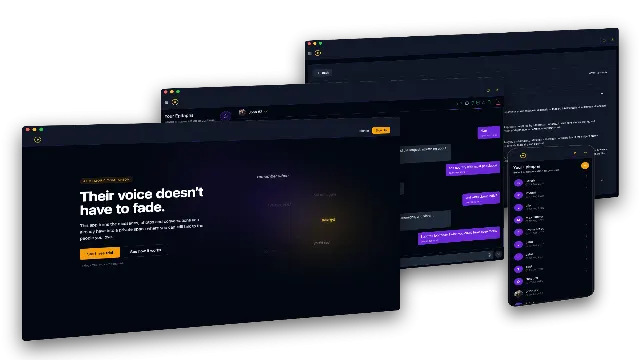
The AI Grief Companion we built for a US startup is an extreme example. The whole product depends on data users bring from other apps, so we wrote parsers for ten chat-export formats, including an Electron app for iPhone backups and a Chrome extension for Discord, and encrypted every message at ingest. The AI pipeline then runs in stages (personality profile, facts, LoRA training, retrieval) and the chat uses whichever stage is ready, so users can talk to the companion about twenty minutes after upload instead of waiting for full training.
How do we choose the model and architecture?
Model and architecture are chosen in stage 3 by measurement: the same evaluation set runs against two or three candidate models and approaches, and the choice follows accuracy, latency and cost per request. Typical candidates are OpenAI and Anthropic Claude models through their APIs, and open models when data must stay on your own servers or a fine-tuned smaller model beats a larger general one on the narrow task.
The architecture options are the same building blocks every time: prompting with templates, retrieval over your data (see RAG development), fine-tuning, and agents that call tools or APIs. Most products combine two of them. We keep the model behind a provider abstraction from the first prototype, because the model you launch with will not be the model you run a year later. For products where generated content is the core value, generative AI development covers the pipeline in more depth.
Which AI products have we taken from idea to production?
We run the AI product lifecycle for clients and on our own products, which means we have lived with the consequences of our own decisions.
- AI Resume Master: our own AI resume builder. We built it in about three months, with LLMs generating, rewriting and improving resume content and cover letters, LinkedIn import and PDF export, on desktop and mobile. It reached 50,000 monthly active users with a SaaS and ad-based model.
- AI Grief Companion: web and mobile apps, chat history ingestion, LoRA persona training on Qwen2.5-7B and retrieval memory, with prompts stored in the database under version history so the tone can be tuned without a release.
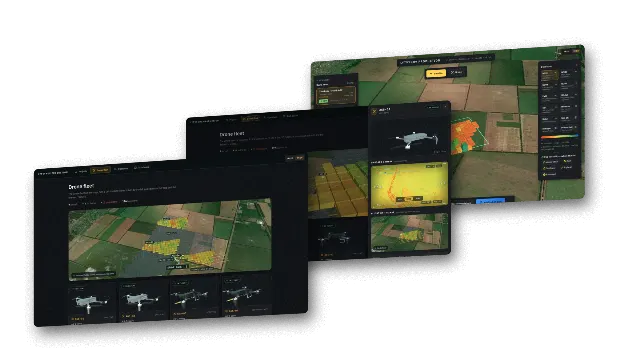
- Autonomous drone swarm prototype: our own R&D, turning Sentinel-2 satellite data into per-zone diagnoses and tasks a fleet picks up without a dispatcher. The aircraft link is simulated while satellite and weather data are real, which is a deliberate prototype-stage choice: prove the decision loop before paying for hardware integration.
What does AI product development cost?
AI product development cost depends mostly on the stage you need, the number of data sources, whether models are hosted or self-hosted, and how much application surrounds the AI. Fine-tuning, self-hosting and native mobile apps add the most effort. Running cost after launch (models, hosting, monitoring) is separate, typically tens to several thousand dollars a month, driven by usage.
We give a fixed quote for each stage after a short scoping call, so you never commit to a full build before the prototype has shown the quality target is reachable. For orientation, an MVP typically lands at $10,000 to $20,000 with us, and a complex AI product with fine-tuning and RAG memory is $60,000 to $150,000; our guide on AI app development cost explains build and run costs in detail.
How we work on AI product development
We start with a 30-minute call about the product, the users and the data you have. If the idea still has open questions about feasibility, we begin with discovery and an evaluated prototype, and you decide on the MVP with measured results in hand. If the direction is already clear, a shorter AI consulting assessment can confirm the plan before the build. Senior engineers lead every stage, we use AI coding agents in our own delivery to move faster, and code, prompts, evaluation sets and model accounts stay in your name. Book an AI product call.