 Es
Es
 En
En
 Fr
Fr
 De
De
 It
It
 Uk
Uk
What does Flutter app development include?
Flutter app development covers designing, building and releasing iOS and Android apps from one Dart codebase. Flutter draws its own interface instead of using platform components, so the app looks and behaves the same on every phone. With us it also includes the back end, the admin panel and, when needed, the landing page, so one team takes the product from design to the stores.
A typical Flutter engagement covers:
- UX and UI design in Figma, with a component library that maps directly to Flutter widgets.
- The app: navigation, onboarding, profiles, search with filters, maps, chat, bookings and payments.
- Push notifications, deep links, analytics and crash reporting.
- The back end: a REST API on Symfony or Node.js, database, admin panel and integrations.
- Store releases: signing, build pipelines, listings, privacy disclosures and submission.
- Launch support: landing page, store optimization and the first releases after feedback.
Why choose Flutter for a mobile app?
Choose Flutter when mobile is the main product, you need both iOS and Android, and design consistency across devices matters. One codebase and one team cover both platforms, and Flutter's own rendering means fewer platform-specific layout surprises.
| Your situation | What we recommend | Why |
|---|---|---|
| Mobile-first product with a custom visual style | Flutter | Identical design on every device, one codebase |
| React web app already exists, JavaScript team | React Native | Shared types and logic with the web |
| Public web pages must rank in search | Next.js for the web, Flutter or React Native for mobile | Each platform uses the right tool |
| Users only need to read and fill forms on the phone | Responsive web app | Cheaper; add native apps later |
| Heavy 3D, specialized hardware, newest OS features | Native Swift and Kotlin | Full platform access |
For the JavaScript side of the comparison see React Native development.
Which Flutter apps have we built?
Our clearest Flutter example is Kodcy, our own pet-boarding marketplace for pet owners who travel. In about three months we built Flutter apps for iOS and Android with:
- Multiple pet management, so owners can book care for several pets at once.
- Multiple host addresses, so hosts can offer care at more than one location.
- A map view of available hosts nearby.
- Real-time chat between owners and hosts.
- Flexible search with filters by pet type, services, dates and distance.
Around the apps we prepared the business plan, backlog and UX/UI design, built a landing page, released both apps, set up social media channels and launched an advertising campaign. Because it is our own product, we made every trade-off a client would make: what to cut to ship on time, and what had to be there on day one.
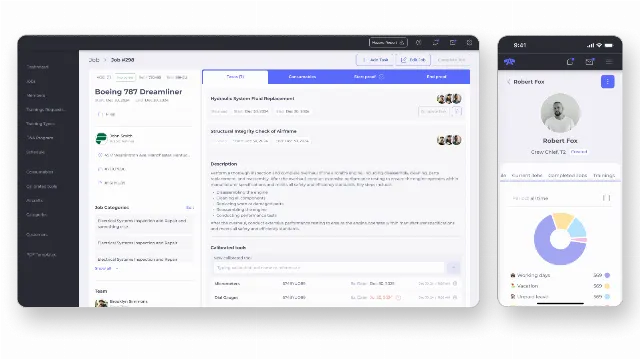
Flutter also appears in the stack of our custom ERP for a US aircraft service company, a six-month build on Symfony/PHP and React that brings client and order management, aircraft service scheduling, staff shifts, warehouse inventory and compliance tracking into one platform used by everyone from ground staff to the CEO.
How do we build Flutter apps that scale?
A Flutter app scales when its structure is decided early: how state flows, how the app talks to the API, and how features are separated so several engineers can work in parallel. Flutter makes it easy to start fast; without rules it also makes it easy to end up with screens that each fetch and cache data differently.
Our defaults on every Flutter project:
- Clear state management chosen once and applied everywhere, with business logic kept out of widgets.
- A typed API client generated from the back end's API description.
- Feature modules with their own screens, state and tests.
- A design system in code: colors, typography, spacing and shared widgets matching the Figma library.
- Tests where they pay: unit tests for business logic, widget tests for key components and integration tests for critical flows such as sign-up and booking.
- Performance on real devices, including mid-range Android phones, before every release.
- Automated builds and signing in CI, with crash and error monitoring from the first internal build.
We use AI coding agents for routine work such as scaffolding, tests and refactors, with senior engineers reviewing every change.
What back end does a Flutter app need?
A Flutter app needs a back end for accounts, data, search, chat, payments and notifications. We build it in the same team, usually a REST API on PHP/Symfony for products with complex business rules and admin needs, or Node.js when real-time behavior is at the core. Keeping both sides in one team means the API is designed around the screens and the app never waits for endpoints.
For products that also need a public website, we pair the Flutter apps with a Next.js or React web side on the same API. See Symfony development and React development for those parts of the stack.
Can you take over an existing Flutter app?
Yes. We start with a code review of the Flutter and Dart versions, packages and their maintenance status, state management, the API layer, build and signing setup, crash reports and store status. You get a written report with risks ranked by impact and a plan that keeps the app in the stores while we work.
The first milestone is usually stabilization: builds and signing moved into CI under your accounts, crash monitoring, fixes for the crashes that affect the most users, and package upgrades where old versions block new OS releases. Only then do we continue with the roadmap. We avoid full rewrites; when a part of the app has to be replaced, we do it feature by feature. For ongoing work after the handover, see our dedicated development team model.
How much does Flutter app development cost?
Flutter cost depends on the number of screens, roles, integrations and the back end. As orientation, with us:
| Project type | Typical timeline | Typical cost with us |
|---|---|---|
| Flutter MVP | 8 to 14 weeks | $10,000 to $50,000 (most $10,000 to $20,000) |
| iOS and Android apps plus web side | 12 to 20 weeks | $20,000 to $50,000 |
| Full online business: apps, admin, payments, integrations | 12 to 20 weeks | $35,000 to $70,000 |
Apple's developer program costs $99 per year and Google Play $25 once. For more on what drives the price, see our guides to MVP development cost and AI app development cost.
How we work on Flutter projects
We start with a short scoping call about the product, the users and what must be in the first release. From that we agree the screens, the back end and the first milestone with a fixed quote. The build runs in milestones with a weekly demo and test builds on your phones, in your repositories and developer accounts. After launch we continue with releases and support, or hand over to your team with documentation. If you are at the idea stage, see our MVP development service.
Tell us about your app on our contact page, or describe the scope in our project estimate form.